Quotidian Galápagos

Puerto Baquerizo Moreno, San Cristobál

Puerto Baquerizo Moreno, San Cristóbal

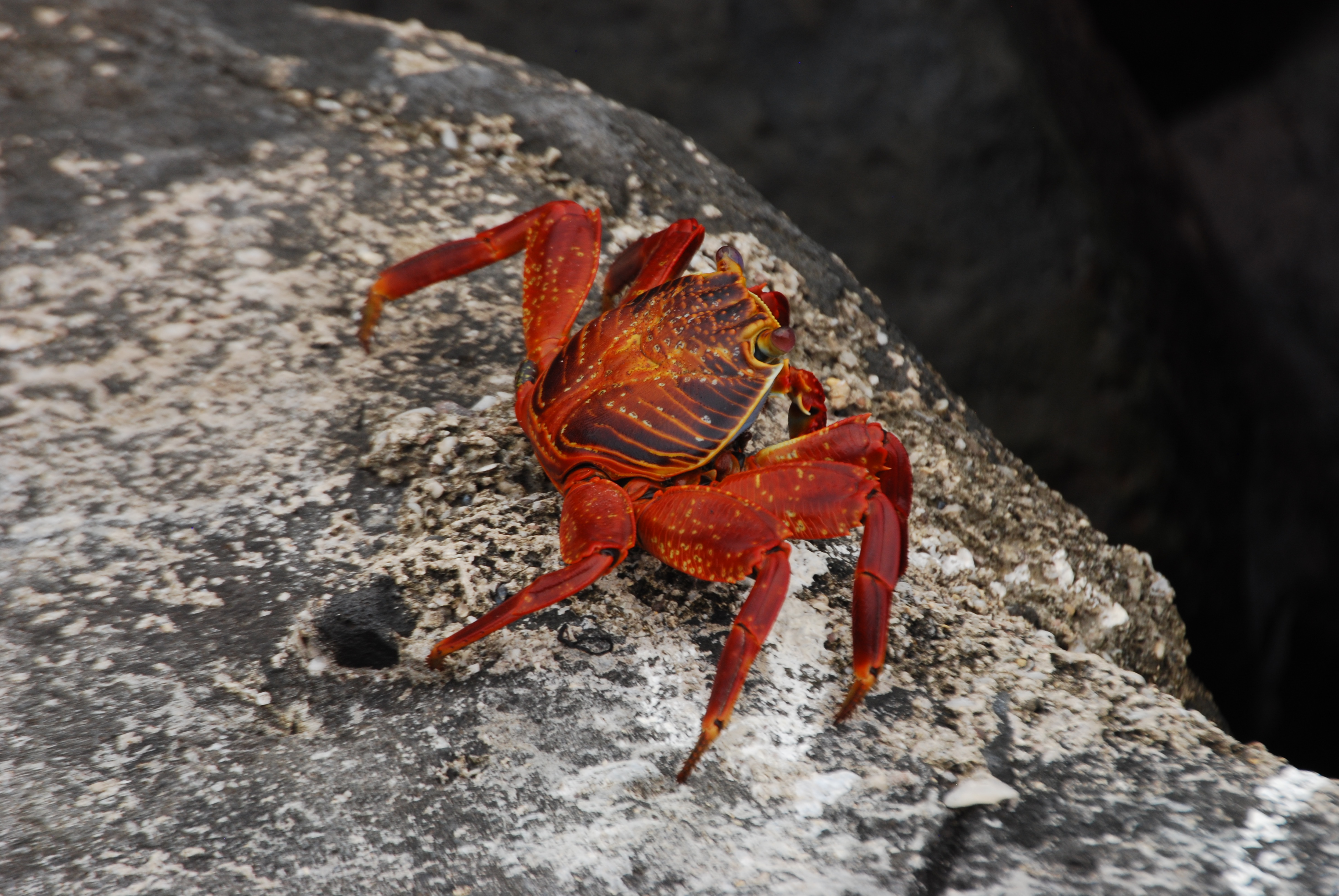
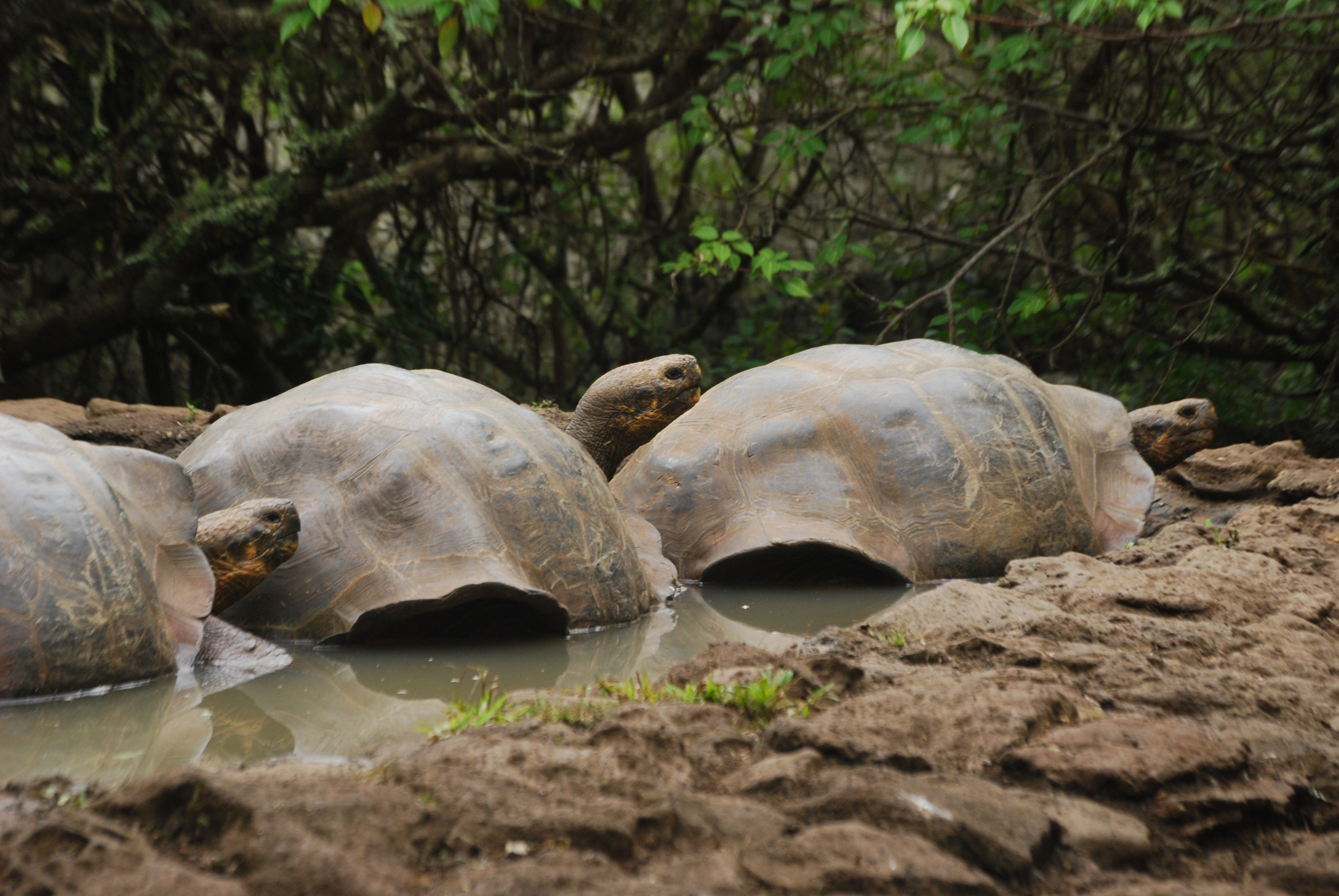
Mornings are quiet and slow, like a full-bodied stretch. More often than not, a fine drizzle covers the island and the early risers walk through it with confidence, knowing it to be temporary. Sea lions blanket the beaches, breaking the silence with all manner of belches and roars and deep-throated coughs. The sky is punctuated with large seabirds keeping an eye on the transparent water, searching for breakfast. Blazing crabs crouch and jump from rock to rock while taciturn iguanas do their best to blend in, usually piled on top of one another.

DSC_0111

If there are guests at the hotel, I wake up early to help serve them breakfast. If not, I sometimes wake up early anyway to walk the malecón, or boardwalk. If I face the northwest, gazing past the moored ships, the rocky headlands, and the endless ocean, I am looking towards home. Thousands of miles away, people I love are hitting snooze on their alarm clocks or putting curlers in their hair. Turning my back to the Pacific, looking over the low buildings of Puerto Baquerizo Moreno, I am facing the direction I will be heading once I leave this sleepy town, the mainland of Ecuador and the countries to the south of it.

The shoreline near La Lobería

The shoreline near La Lobería

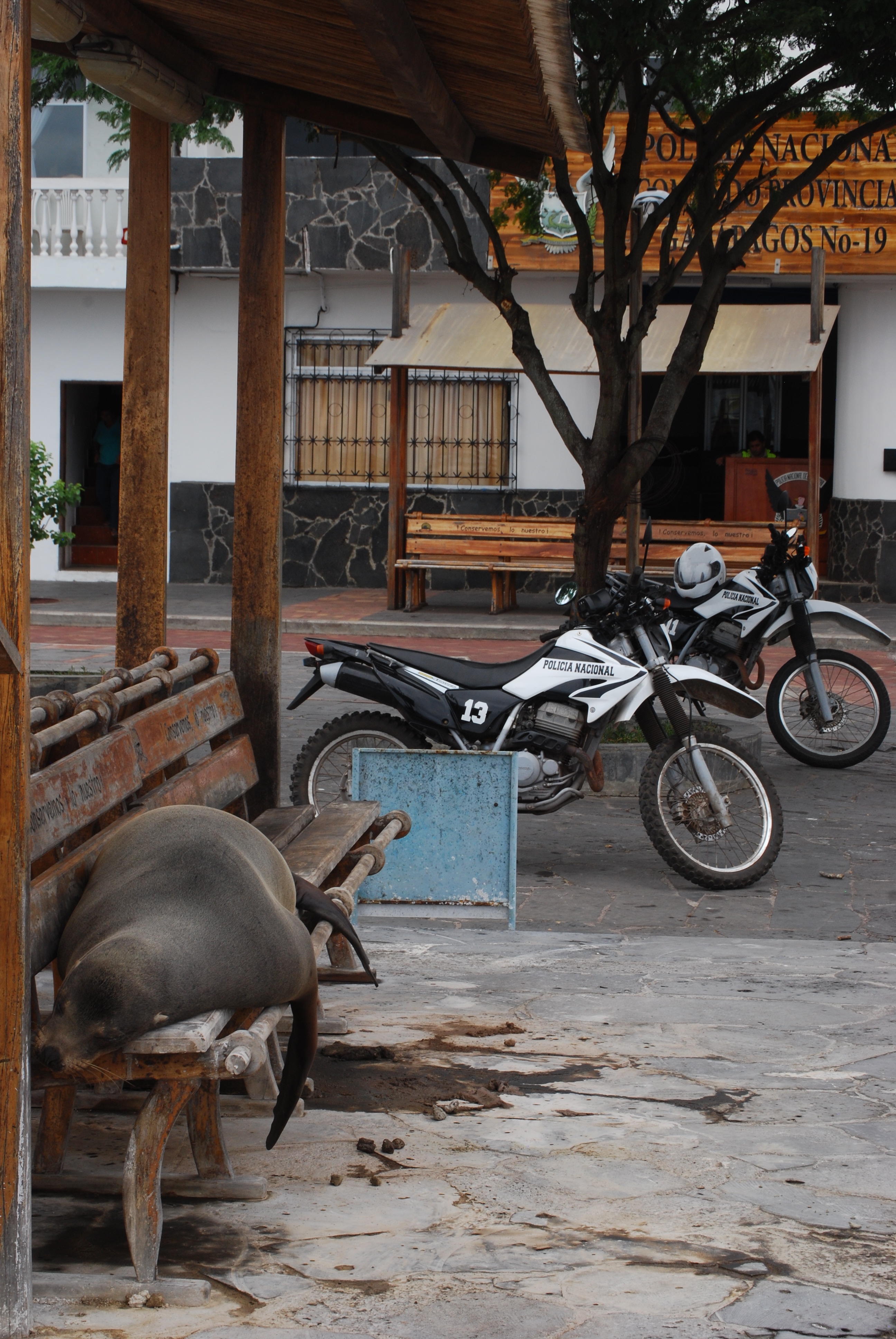
The pace does not pick up much as the day progresses. Stores that opened only a short while before close for a few hours for lunch and a siesta. Humans and sea lions (or lobos marinos) alike find benches to recline on, the former chat quietly, the latter move only in order to situate themselves more comfortably. The sea lions are everywhere, and the mindful stroller knows to watch out for them underfoot as they don’t take kindly to being stepped on.

DSC_0083

As ungainly and clownishly as these creatures (the sea lions, not the humans) move on land, their movements underwater are more graceful than anything I’ve seen. I have had the pleasure of being able to observe them from the ocean floor during scuba sessions, where they come close enough to bite my floating hair and watch me curiously and without fear. I can’t even explain how beautiful it is to breathe underwater and, looking up, see the bubbles race towards the air, the sunlight refracting through the water like molten gold, while the sea lions dart and spin through sunbeams like birds on the wing.

bccf1cf8582fde0d7770b39d1a7c68f3

The beauty here, on this outpost of land that inspired the theory of evolution, is something to be felt more than seen. It sits at the back of your throat. You sense it behind your knees, in the pit of your stomach, it climbs the vertebrae of your spine, and curls up at the base of your skull. I wish I could leave a piece of my consciousness here, so that I could come back to it in a moment and relive the tranquility and corporeal beauty of it. I want to swallow a part of it and carry it with me. I want to sink into the sea and become as all-encompassing as it is, touching both home and this island at once.

DSC_0119

Night steals silently in, turning the sea from aquamarine to indigo, the stars slowly wrapping themselves in brilliance like mantles. Wind swoops in from across the water, washing away the scent of human activity, breathing freshness into the dusk. I watch sea lions lumber onto the beach; the pups nuzzle against their mothers seeking food and comfort. People close up shop and wander the streets, calling out to one another in passing. Tourists and locals alike have a Pilsener at one of the handful of bars. But usually before midnight, silence returns like the prodigal son, and everything begins again.

DSC_0155

I found this quote by the poet Robert Pinsky in the book I was reading today while sitting on the boardwalk with my back to the sea. I wrote it on my arm so I could immediately commit it to memory.

When I had no roof, I made audacity my roof.

That about sums up this whole trip.DSC_0004

La Puntica No Más

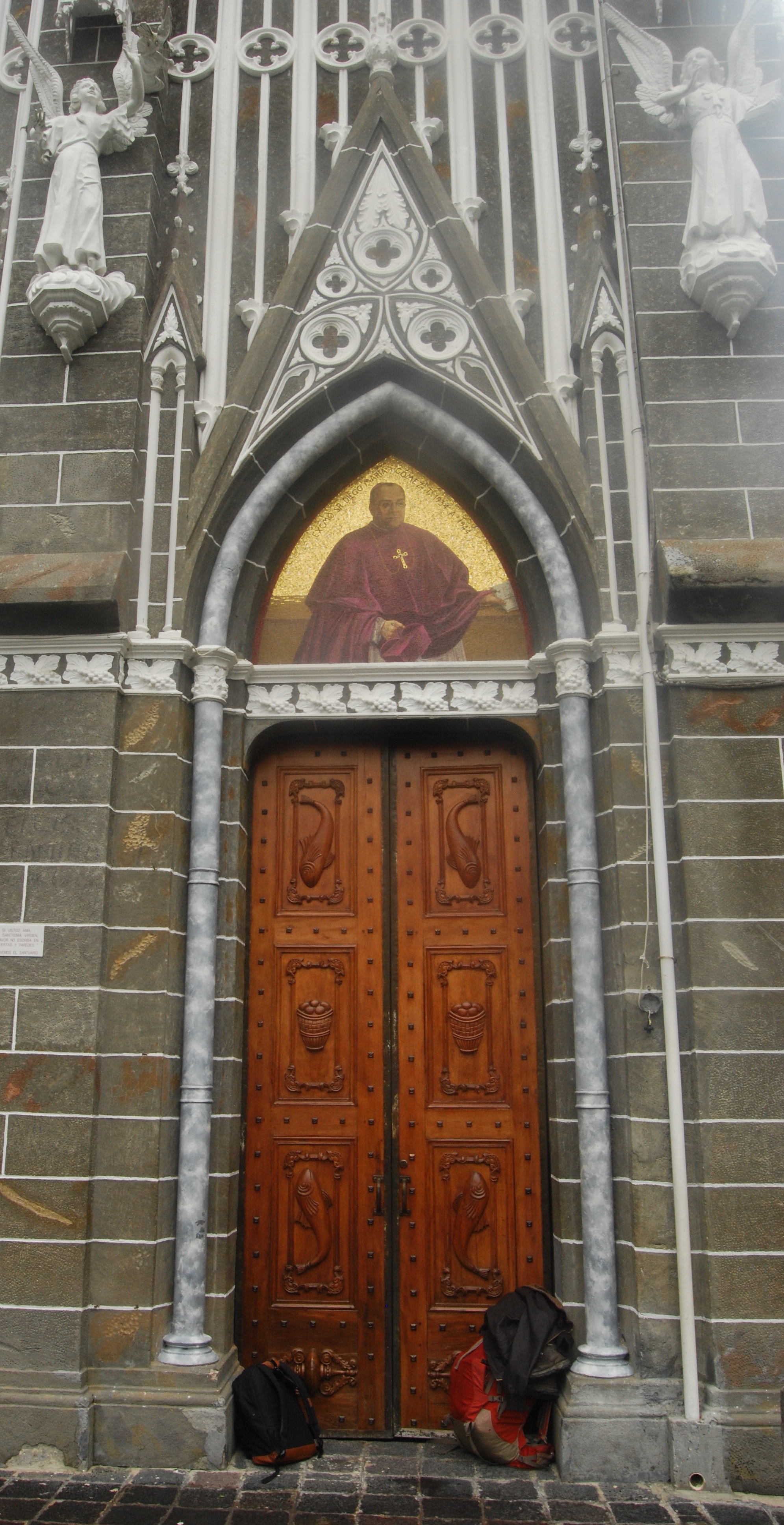
My bags sheltering from the rain as I photograph Las Lajas cathedral on the border of Colombia and Ecuador.

My bags sheltering from the rain as I photograph Las Lajas cathedral on the border of Colombia and Ecuador.

Sleeping in hammocks for the first time, in the middle of the Colombian jungle, while listening to a simultaneously soothing and eerie chorus of frogs. Casually discussing the proliferation of microbreweries in the United States versus the availability of different beers in Europe with a dreadlocked Swede while very carefully descending 1,200 millenia-old, damp, and slippery steps from the Lost City of the Tairona Indians. Sitting in a bar which from the outside looked like a simple tienda, drinking $2 shots of shitty tequila and dancing merengue, and ending up with a bunch of other foreigners in a Chilean’s wine bottle-lined apartment, listening to a German chick sing La Llorona like Lila Downs herself and again, dancing. Holding on tightly, but not too tightly, to an 18-year old boy on a motorbike as he spirited me up a muddy slope in the pouring rain. Getting mugged. Twice. Sitting in a ramshackle bakery, eating corazones and dipping them in cup after cup of hot chocolate. Ajiaco. Eating bags of caramel crispetas on long bus rides. Watching my brother white-knuckle the saddle of the horse he was unwillingly riding at breakneck speed in Tayrona. Almost cracking my skull open on a see-saw, or mataculín. Sitting in an underground cathedral with an exorbitant entrance fee, cracking irreverent jokes with two of my favorite people… 

Jess drinking a "coco loco" in Santa Marta.

Jess drinking a “coco loco” in Santa Marta.

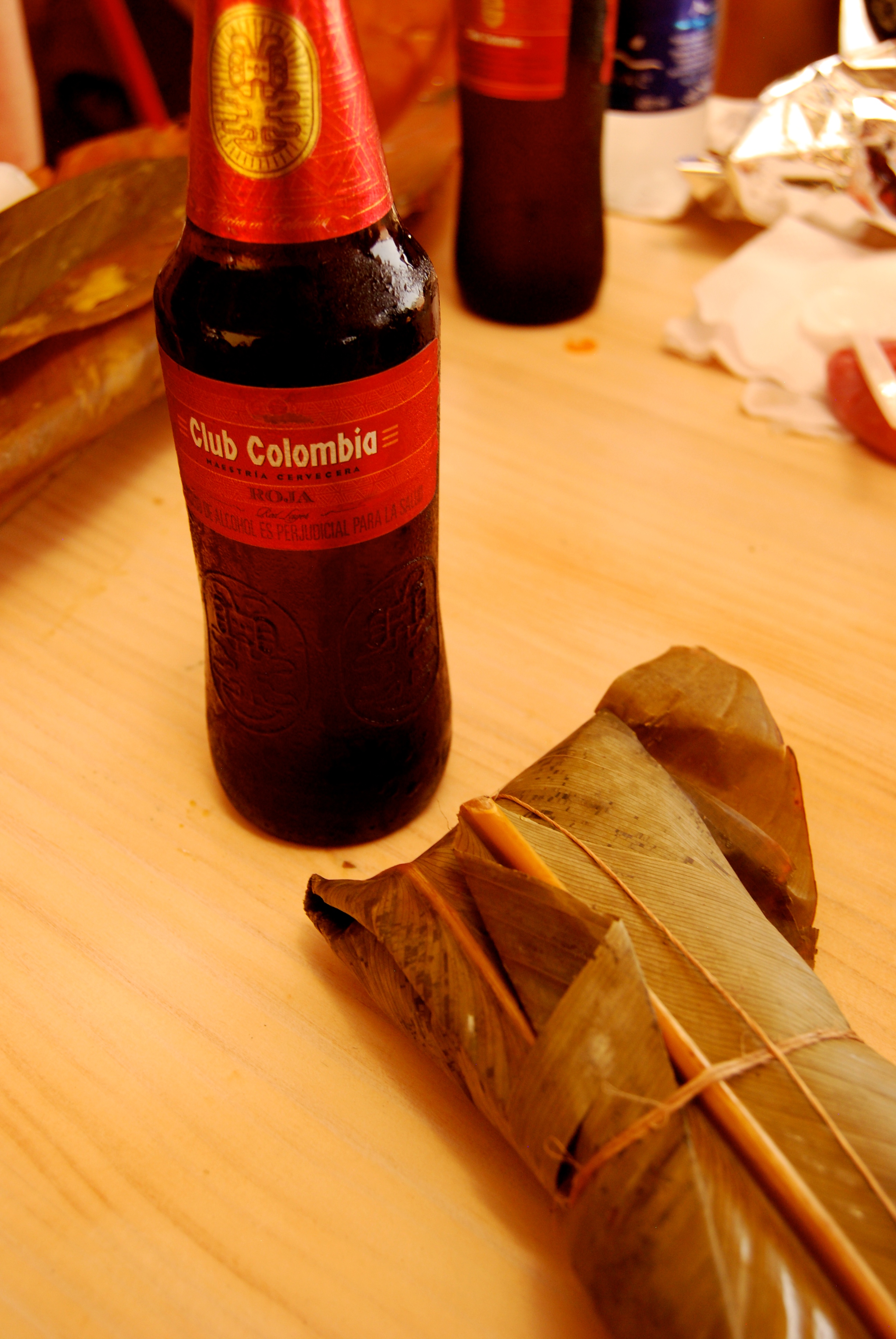
My favorite Colombian beer and a tamal.

My favorite Colombian beer and a tamal.

These are some of the things I think about when I think about my time in Colombia. Many of them are things I will never forget, but others will be lost in the shifting sands of my memory, only occasionally resurfacing, bleached white like the skeletons of small mammals, or not at all. I wouldn’t trade my time there for anything. I learned many things, about the world and about myself, both good and not so. I both realized how capable I am of taking care of myself (potential muggers beware) and how fragile and vulnerable I am. This is what is valuable to me. This is why I travel. Not to lie on a beach and drink obnoxious cocktails, wallowing in the evanescent feeling that time has left me behind, though there is a time and a place for that, but, as an essay I recently read by Pico Iyer so beautifully put it,

We travel, initially, to lose ourselves; and we travel, next, to find ourselves. We travel to open our hearts and eyes and learn more about the world than our newspapers will accommodate. We travel to bring what little we can, in our ignorance and knowledge, to those parts of the globe whose riches are differently dispersed…. I travel in large part in search of hardship—both my own, which I want to feel, and others’, which I need to see.

Ajiaco, a potato-based, delicious chicken soup, served with white rice, lentils, cream, and avocado. I got this one at La Puerta Falsa in Bogotá.

Ajiaco, a potato-based, delicious chicken soup, served with white rice, lentils, cream, and avocado. I got this one at La Puerta Falsa in Bogotá.

The salt cathedral of Zipaquirá.

The salt cathedral of Zipaquirá.

Of course, a large part of travel is seeing places very different to home, trying foods you’ve never heard of, etc., but a larger and much more important part is seeing how other people in the world live. Walking through Colombian cities and towns, watching places slide by on buses, I have seen wealth and poverty, both comparable to and vastly different from what we have in California. But taking yourself out of your own context teaches you what you value, take for granted, or never give a second thought to. I rarely stopped to consider the plumbing in my last apartment in San Francisco, but in Colombia, where you have to throw all your toilet paper in a basket next to the toilet (where it sits until someone takes it out), I find myself thinking fondly on that efficiently flushing porcelain depository. I miss washing machines and Walgreen’s, fresh greens and vegetables, the voices and embraces of my friends and family. I feel like an heiress walking around here with a  laptop computer, an iPod, an iPhone, and a Kindle. The hourly minimum wage in San Francisco is equivalent to what some people here make in a week, if that.

On my first mototaxi in Minca.

On my first mototaxi in Minca.

Mom, Gregory, and I on the coffee tour of Hacienda Guayabal in Chinchiná.

Mom, Gregory, and I on the coffee tour of Hacienda Guayabal in Chinchiná.

But in spite of the fact that I am glad I came, I am also very glad that I have left Colombia behind. What I am about to say, I want you to take with a grain of salt and with the knowledge that this is my personal experience, and does not reflect on other people’s experiences of the country and its people as a whole. There was a feeling in Colombia that I could not shake off, one that had me constantly looking over my shoulder and made me want to stay indoors after sunset. I felt this before I was mugged twice in Bogotá, and I felt it after. I felt it when I was in the presence of friends and family, including Colombians, and I felt it, admittedly more so, when I was alone. It had a lot to do with the way strangers treated me. A large percentage of the men gave me looks that, frankly, chilled me. It was as though they were laying claim to me simply by looking, taking a piece of me that was not freely given. I’ve lived in Mexico, where they are notoriously flirtatious with women and catcalling is very common, but this was different. It did not feel playful to me. In general, nothing was said. I would just see them staring at me, and feel their eyes on me as I walked away, as calmly and intentionally as I could. If they did say something, it was a hiss or a bark, or they would switch to English, “Hey! HEY!” louder and louder, like they thought I would only respond to a certain decibel level in my own language. No one ever touched me, not once. But I felt as if they had, and it scared me. Many women I passed on the street or who I spoke to in restaurants or shops were also less than friendly, as if I was on their territory without permission, unwelcome. I have never felt this way in any country I’ve traveled to. Not ever. It could have something to do with all the negative things I’ve grown up hearing about Colombia; perhaps in spite of my conscious efforts to maintain an open mind, these things wormed their way into my heart like an untraceable poison, darkening my perception. In spite of this, there were many people whom I did meet who were very kind and generous, who were happy to meet someone from a different country, who took it almost as their duty to make sure I had a good time getting to know their city. I’ve already mentioned Esneider and Carlos in Medellín, but they bear mentioning again for their sheer awesomeness. Ana María in Bogotá without whom I might have let the double muggings completely spoil my time in that city. Our guide on the tour to the Ciudad Perdida, Gabriel, who practically adopted us during the hike and took it as his personal duty that none of us should pass out and be forgotten in the Colombian Sierra. The countless strangers who went out of their way to tell us what and where to avoid, the things we shouldn’t miss, and in general give good advice. I haven’t forgotten them.

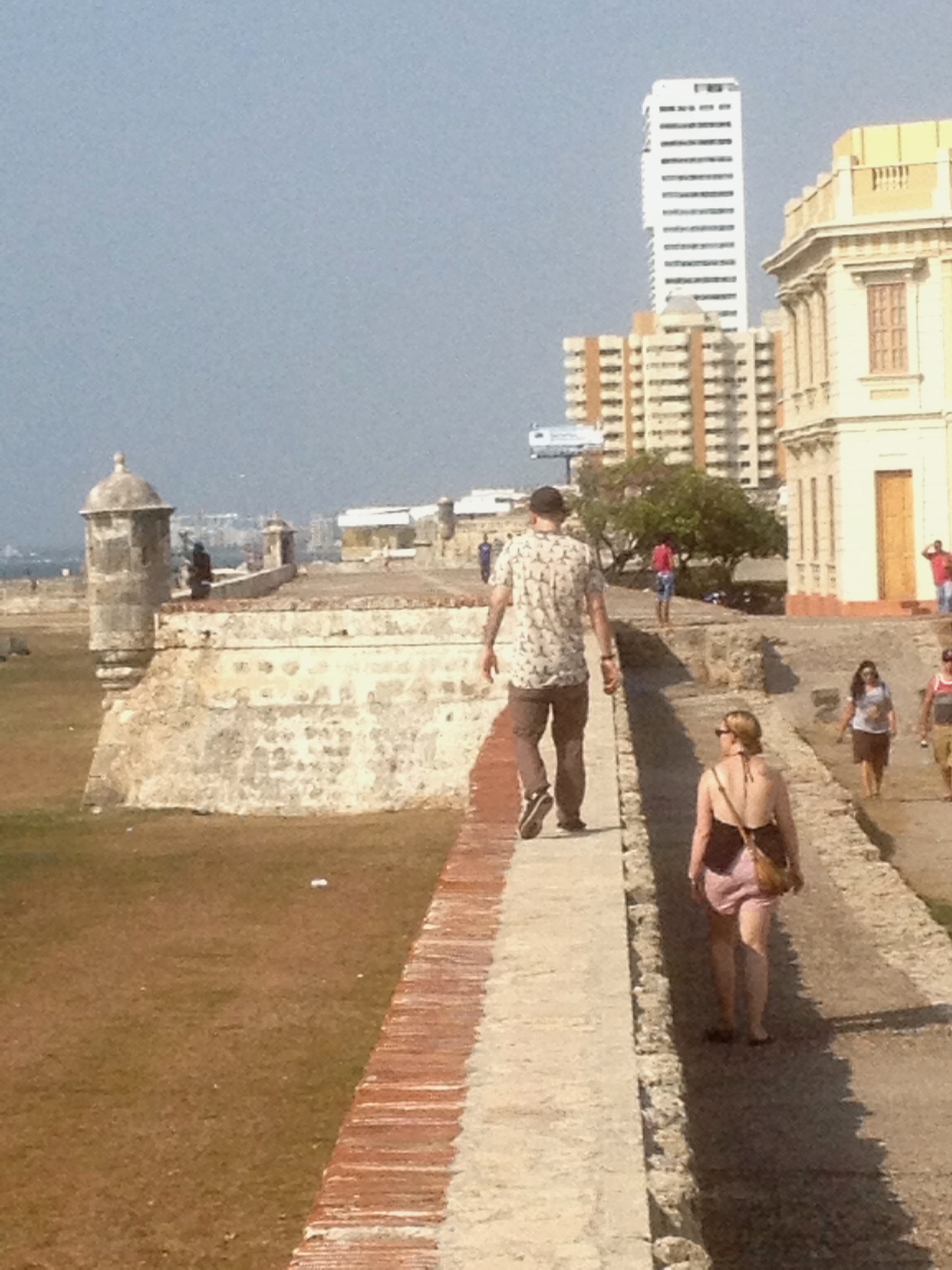
My brother, Gregory, and I walking the wall in Cartagena.

My brother, Gregory, and I walking the wall in Cartagena.

Picking coffee.

Picking coffee.

But I truly did breathe a sigh of relief when I crossed the border into Ecuador. There are things that I would have liked to see in Colombia like La Guajira and the river of many colors, but time (and money) are always limited. I know that I only familiarized myself with the tip of the iceberg that makes Colombia and its people what they are. I know that there is much to be loved and appreciated about that country of so many different climates and cultures and lifestyles. Which is why I chose to name this blog after a saying I learned in Medellín from a poster of sayings that identify a paisa (a person from Medellín): La Puntica No Más, which actually means “just the tip”, though I have reappropriated the meaning, if you catch my drift.

The Rebellion Inherent in Being Who YOU Want to Be

I wrote this for my dad’s magazine Under the Same Sky. The upcoming issue’s theme is “Rebellion” and I thought I could add something to the conversation by talking about my travels. Enjoy!

Rebellion is a heavily-loaded word, one thick with connotation, a word whose meaning if not form dates at least as far back as the human race. In its historical sense, it usually comes armed, wielded in the hands of the colonized, the oppressed, or simply the dissatisfied. In art it often manifests as abstraction or the surreal, breaking tradition with a brushstroke. It can be bloody or peaceful, silent or cacophonous, but it is always, at its heart, a breaking away from what is expected.

Rebellions have accounted for some of the most important developments in history: the American Revolution (revolution being a more sophisticated form of rebellion), the women’s suffragette movement, the battle for gay rights, etc. But there are an infinite number of rebellions that happen every day, that will never be written down in any books, that may not even go by their proper name. Sometimes we don’t even realize we are in fact rebelling until, slowly or all at once, it becomes clear.

As a woman traveling South America alone, it has been the comments of both friends and strangers as well as their reactions to what I’m doing that has convinced me that I am, essentially, rebelling against the norm. In the United States, it has become accepted and even expected to travel when you’re young or in college because, as I’ve heard countless times in my life, “it gets harder to do as you get older”. But while it may be more common in my generation, what is not quite as explicit is the assumption that one will eventually put aside childish things and put on the yolk of adulthood and the trajectory of a life, a woman’s life especially, is expected to include marriage and children.

So if traveling abroad is so common, what about my personal experience is rebellious? Just this: that I am a 26 year-old woman and in Latin America, specifically, I should already have at least a husband, if not one or more children. Probably about 80% of the conversations I have had with people in Colombia and Ecuador have included, within the first few sentences, “Where is your husband?” or “How many children do you have?” When I answer in the negative, or, more often, laugh, they smile and say “Oh, then you must have a boyfriend?” It is only then, when I answer that I am single and not only that, but happily so, and even worse, have no intention of either getting married or having children that their smile turns uncertain, as if they are no longer sure exactly who or what they are dealing with.

What is happening here is that I, as a single woman who finished school almost 5 years ago, fall outside of what is considered the norm in Latin America. I have been asked if I am “worried” about the fact that I’m single or offered, as if it was an Advil for a headache, to be set up with friends of these people, people I know little if at all. This is not to say that back at home there are not other women like me, as I know many, but here, in a place where it is very common to marry and have children at a young age and not common at all to actively not pursue either of these things, I am an oddity. 

But it is not this alone. The idea of macho men as well as stricter gender roles are embedded in Latin culture and as such I have found that men are substantially more prone here than in the U. S. to catcall women. Back at home in California, I feel equipped to handle catcalling, armed with the comfort of being in a place and within a culture I am intrinsically familiar with. But when I am in new cities, in a constant state of uprooting and traveling, catcalling takes on a much more threatening cast, especially when I’m alone. Men have even attempted to rob me here, luckily unsuccessfully, in part because as a woman I am seen as vulnerable. Thus, I have found that it has taken a good deal of courage to continue on, to wear the clothes I feel represent me, and to walk the streets of foreign cities, exploring and finding new places to love, in spite of the moments when men have made me feel as though I would like to hide or wish that I did have a boyfriend or husband to “protect” me. 

Rebellion does not have to be a momentous and organized event. You do not have to march bare-breasted through the streets of San Francisco or wear anarchist badges on your distressed denim jacket to be a rebel (though by all means, do so if that’s your thing). It may not even be noticed by other people, since the smallest act can be a rebellion, too. Even walking down a street and ignoring (or giving the finger to) catcallers is a rebellion, or unashamedly answering questions to which the askers assume they already know the answer. Being a woman, or a man, or anywhere in between for that matter, and brazenly asserting your right to live the life you want, even if it goes totally against what is expected of you by society, is the ultimate rebellion.

Genocide and Slavery: Pitstops on the Road to El Dorado

[To reach El Dorado] they crossed swamps and lands that steamed in the sun. When they reached the banks of the river, not one of the thousands of naked Indians who were brought along to carry the guns and bread and salt remained alive. As there were no longer any slaves to hunt down and catch, they threw the dogs into vats of boiling water… (Eduardo Galeano, Memory of Fire, p. 99)

DSC_0123

Of the multitude that followed him, one hundred and sixty exhausted Europeans and not one Indian remain. Leveler of cities, founder of cities, Benalcázar has left behind him a trail of ashes and blood and new worlds born from the point of his sword (100).

DSC_0128

They left Peru months ago in search of the lake where according to legend there are solid gold idols as big as boys, and now they want to return to Peru on a war footing. They won’t spend another day in pursuit of the promised land, because they realize that they already found it and are sick of cursing their bad luck. They will sail the Amazon, emerge into the ocean, occupy Margarita Island, invade Venezuela and Panama… (133-4)

DSC_0132

…the Taironas, bled white by so many years of tribute and slavery, scatter in defeat. Extermination by fire….– everything burns. How many worlds do these fires illuminate? The one that was and was seen, the one that was and was not seen…. the Taironas flee into the mountains…. Far up there the invaders have expelled them, seizing their lands and uprooting their memory, so that in their remote isolation oblivion may descend upon the songs they sang when they lived together, a federation of free peoples… so that they should never again remember that their grandparents were jaguars. Behind them they leave ruins and graves (170-71).

DSC_0133Gold escudos in hard cash, doubloons, double doubloons, big-shot gold and little-shot gold, gold jewelry and dishes, gold from chalices and crowns of virgins and saints: Filled with gold are the arriving galleons of Jean-Baptiste Ducasse, governor of Haiti and chief of the French freebooters in the Antilles…. To France goes the gold of the sacked Spanish colony. From Versailles, Ducasse receives the title of admiral and a bushy wig of snow-white rolls worthy of the king. 

Before becoming governor of Haiti and admiral of the royal fleet, Ducasse operated on his own, stealing blacks from Dutch slave ships and treasure from galleons of the Spanish fleet. Since 1691, he has been working for Louis XIV (277-8).DSC_0138[Fray Bartolomé de las Casas] addresses himself directly to the Holy See. He asks Pius V to order the wars against the Indians stopped and to halt the plunder that uses the cross as an excuse (143).

DSC_0139Antonio de Montesinos, Dominican friar… denounces the extermination:

“By what rights and by what justice do you hold the Indians in such cruel and horrible bondage? Aren’t they dying, or better said, aren’t you killing them, to get gold every day? Are you not obliged to love them as yourselves? Don’t you understand this, don’t you feel it?”

…. A murmur of fury swells up. They didn’t bargain for this, these peasants from Estremadura and shepherds from Andalusia who have repudiated their names and histories and, with rusty arquebuses slung over their shoulders, left at random in search of mountains of gold and the nude princesses on this side of the ocean. A Mass of pardon and consolation was what was needed by these adventurers bought with promises…. (57-8).
DSC_0145St. Augustine authorizes war against those who abuse their liberty, because their liberty would make them dangerous if they were not tamed….

Before they start the rush for the gold, for nuggets possibly as big as eggs, [the Spanish lawyer Martín Fernández de Enciso] slowly and meticulously summons the Indians to leave these lands since they don’t belong to them, and if they want to stay to pay their highnesses tribute in gold in token of obedience.

The two chiefs listen… to the odd character who announces to them that in case of refusal or delay he will make war on them, turn them into slaves along with their women and children, and sell and dispose of them as such and that the deaths and damages of that just war will not be the Spaniards’ responsibility.

The chiefs reply… that the holy father has indeed been generous with others’ property but must have been drunk to dispose of what was not his and that the king of Castile is impertinent to come threatening folks he does not know.

Then the blood flows (59-60).

DSC_0003

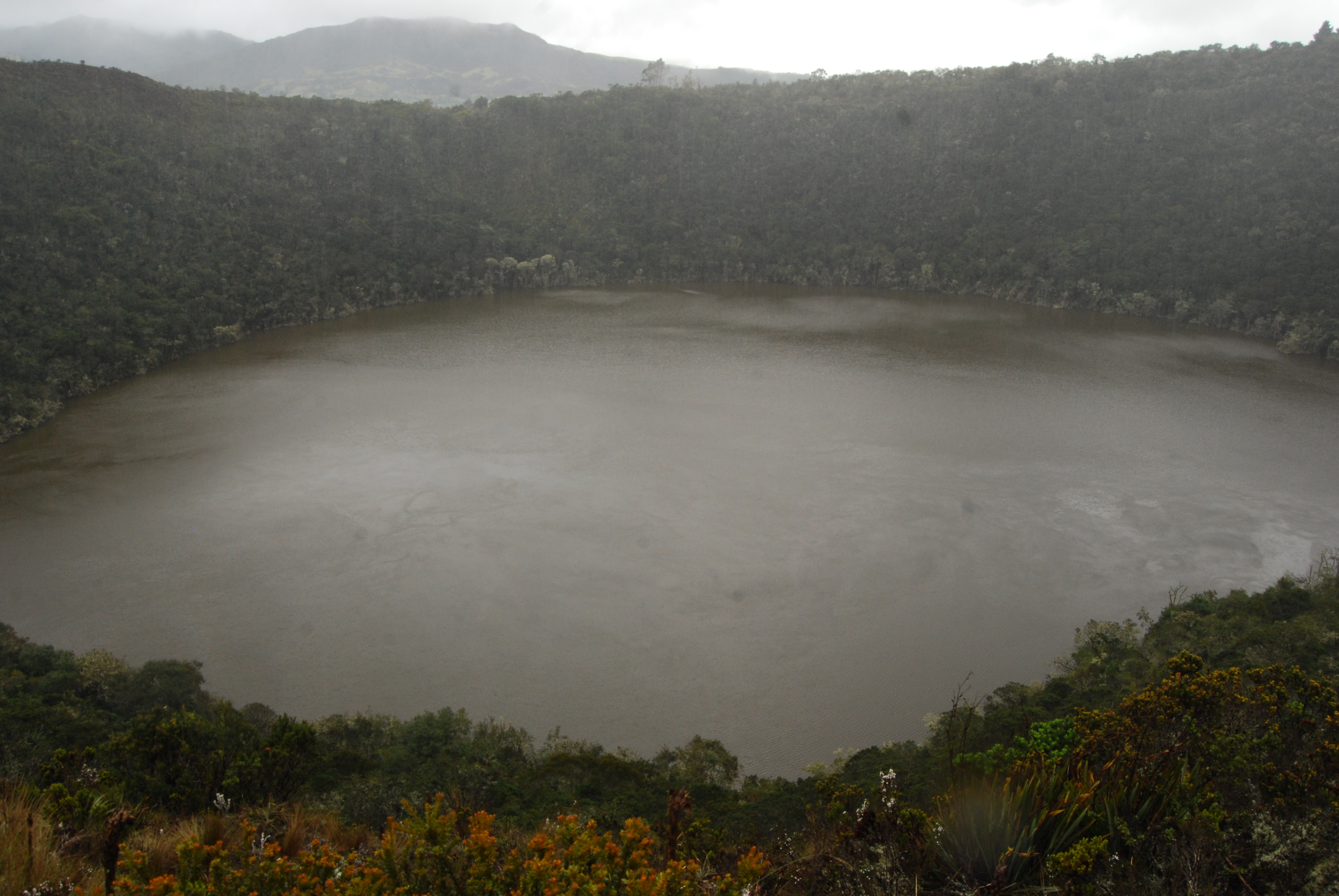
The lake at the heart of the El Dorado legend, outside of Guatavitá, Colombia.

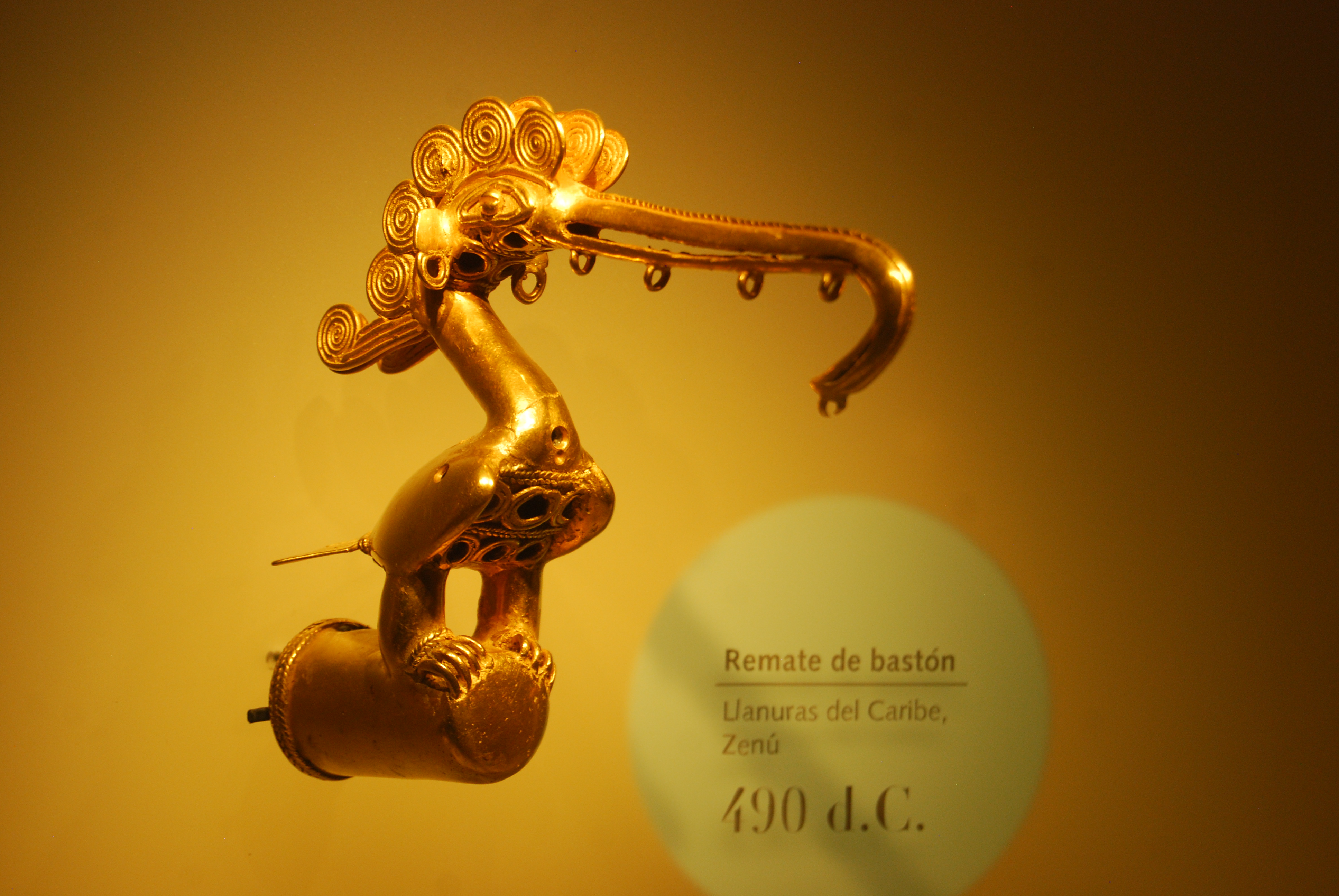
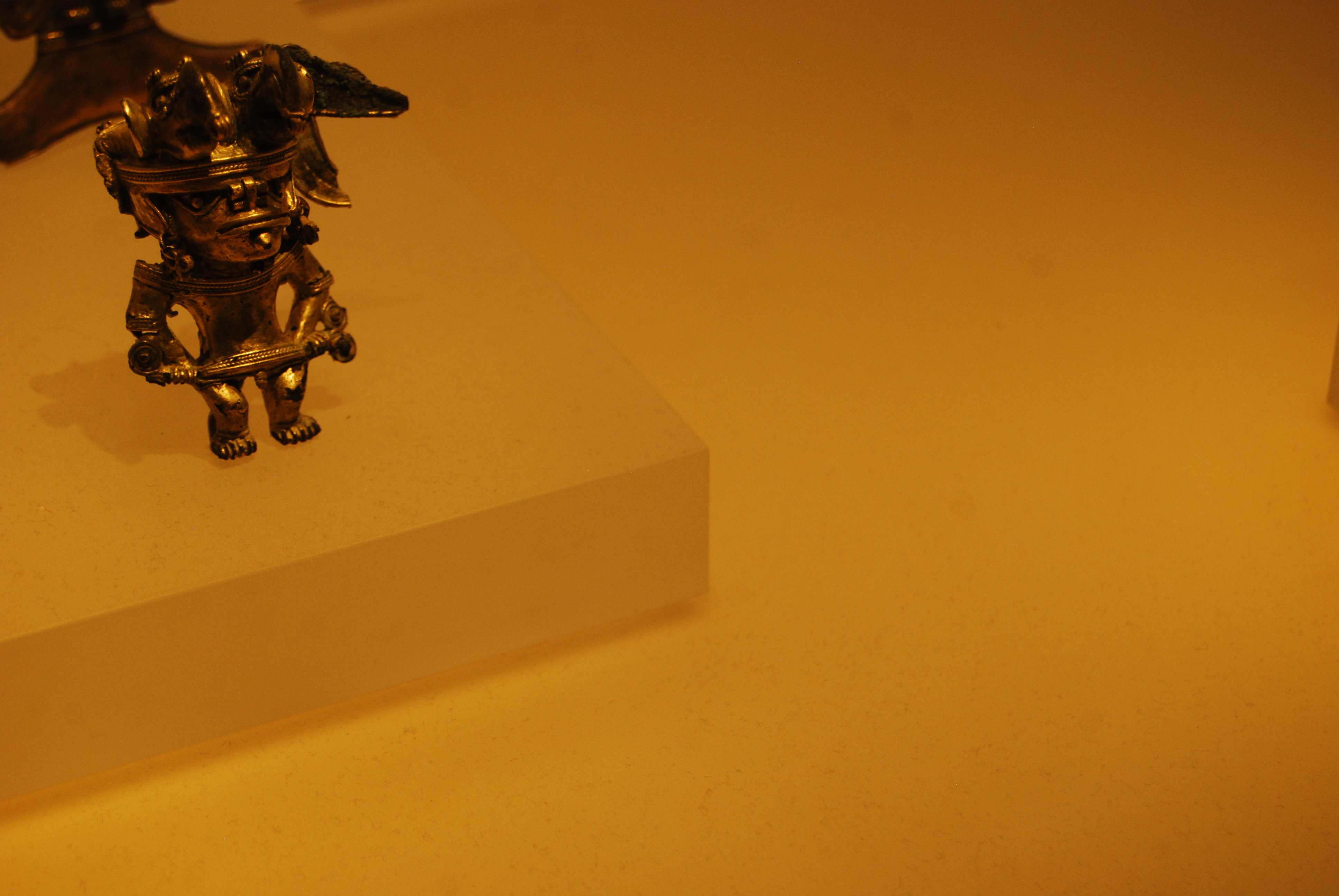
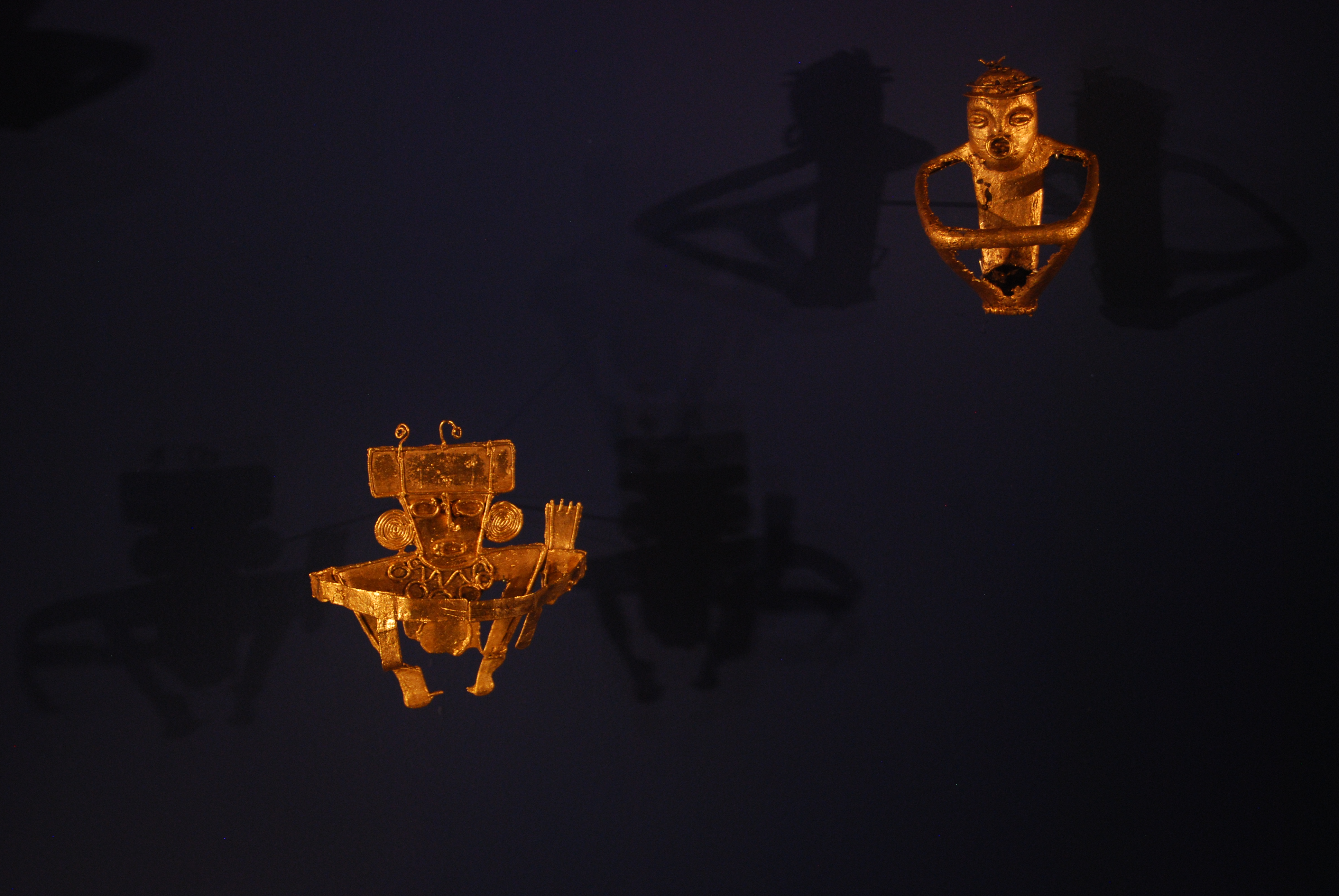
The Museo de Oro (Museum of Gold) in Bogotá is one of the main tourist attractions, even meriting its own metro stop. The gold was beautiful. The jewelry and figurines and ceremonial objects were created with a level of workmanship and attention to detail that was breathtaking. And yet, if the horrors caused by the Europeans’ covetousness of this gold was mentioned once, it was only in passing and never the focus. But that was all I could think about: the immeasurable amount of blood that was spilt, lives taken or enslaved, worlds annihilated… because this gold was so precious to this continent’s conquerors, more precious than the lives of children and women and men. Gold to which they felt entitled because of the color of their skin and the power of their God.

It makes me think about the kinds of things today’s conquerors covet, the kinds of resources that make death and exploitation into “necessary evils”.  I’m sitting here, in Medellín, Colombia, thinking to myself: Has anything changed at all?

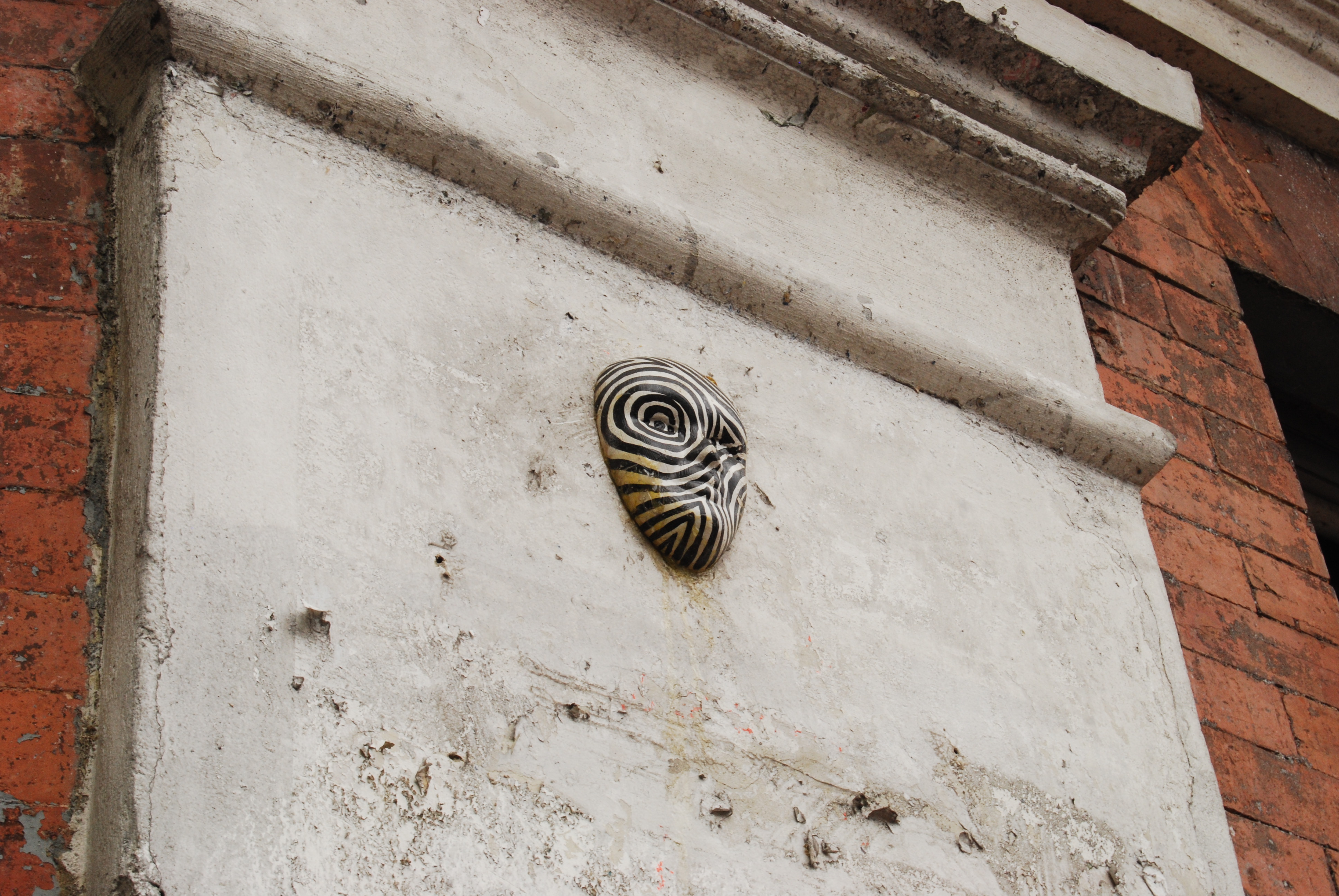
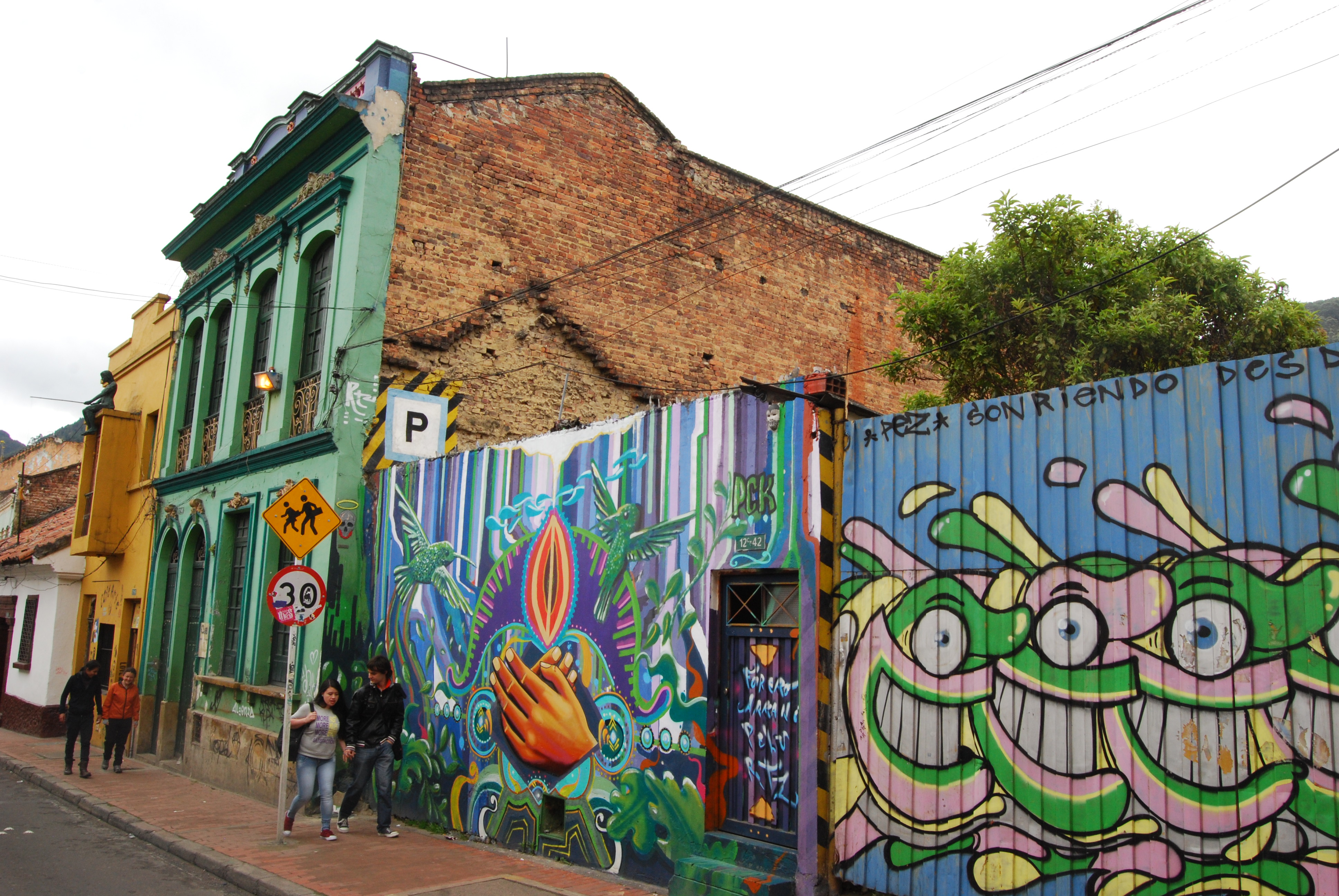
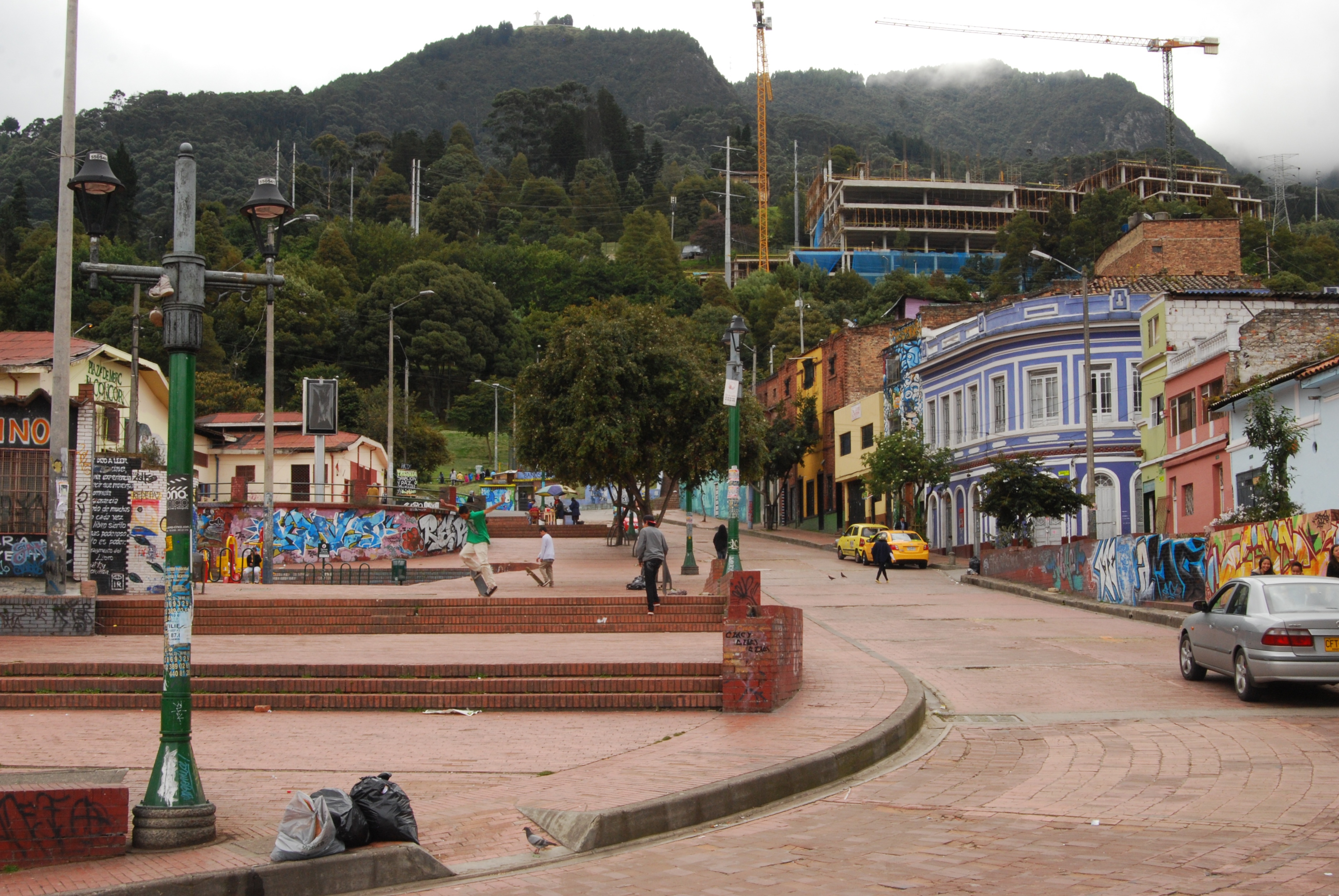
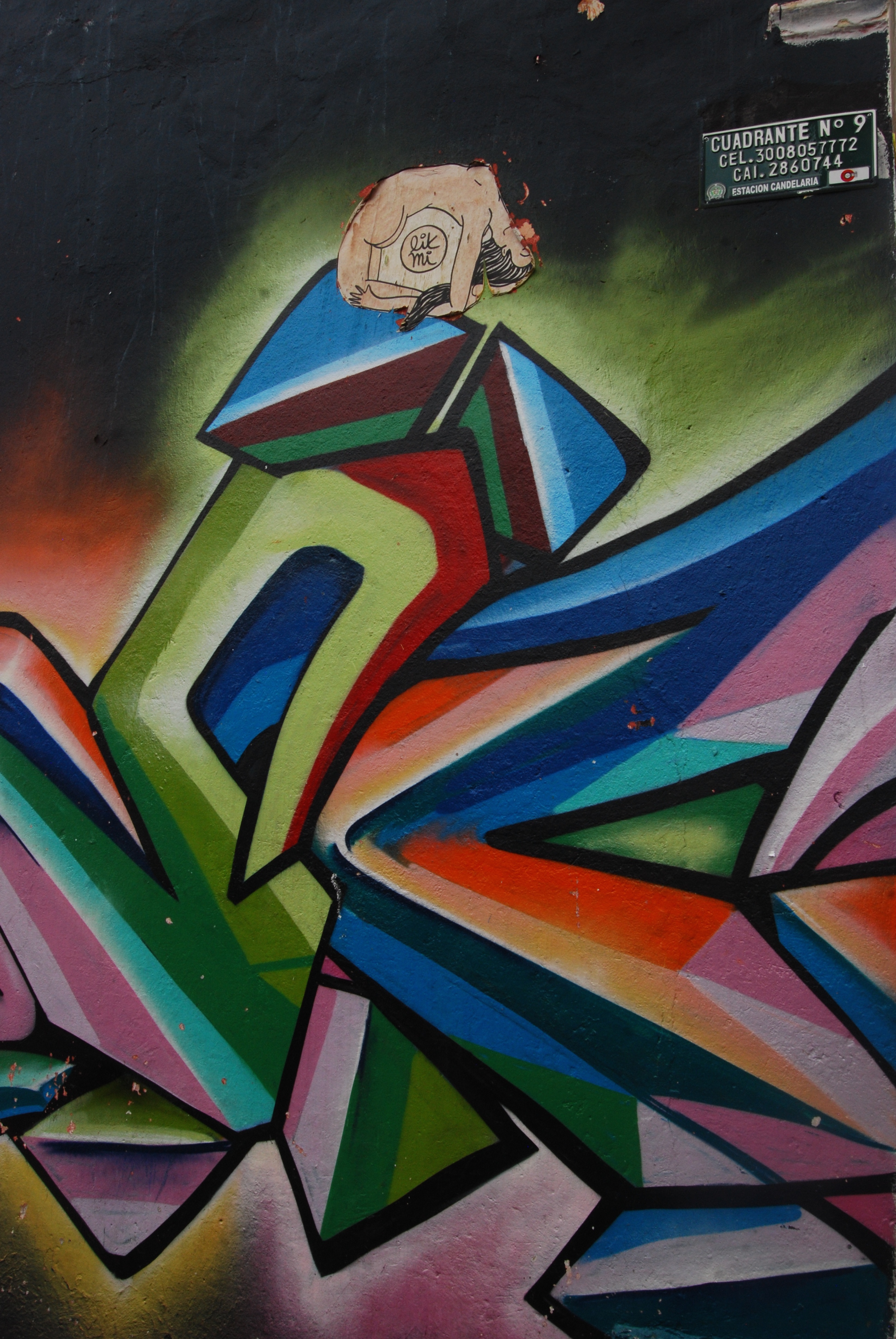
Walls Speak Volumes in Bogotá

DSC_0015

DSC_0019

DSC_0026

DSC_0023

DSC_0027

DSC_0030

DSC_0034

DSC_0040

DSC_0049

DSC_0045

DSC_0051

DSC_0058

DSC_0072

DSC_0065

DSC_0088

DSC_0063

DSC_0084

DSC_0117

DSC_0081

DSC_0121

DSC_0099

DSC_0111

DSC_0132

DSC_0133

DSC_0140

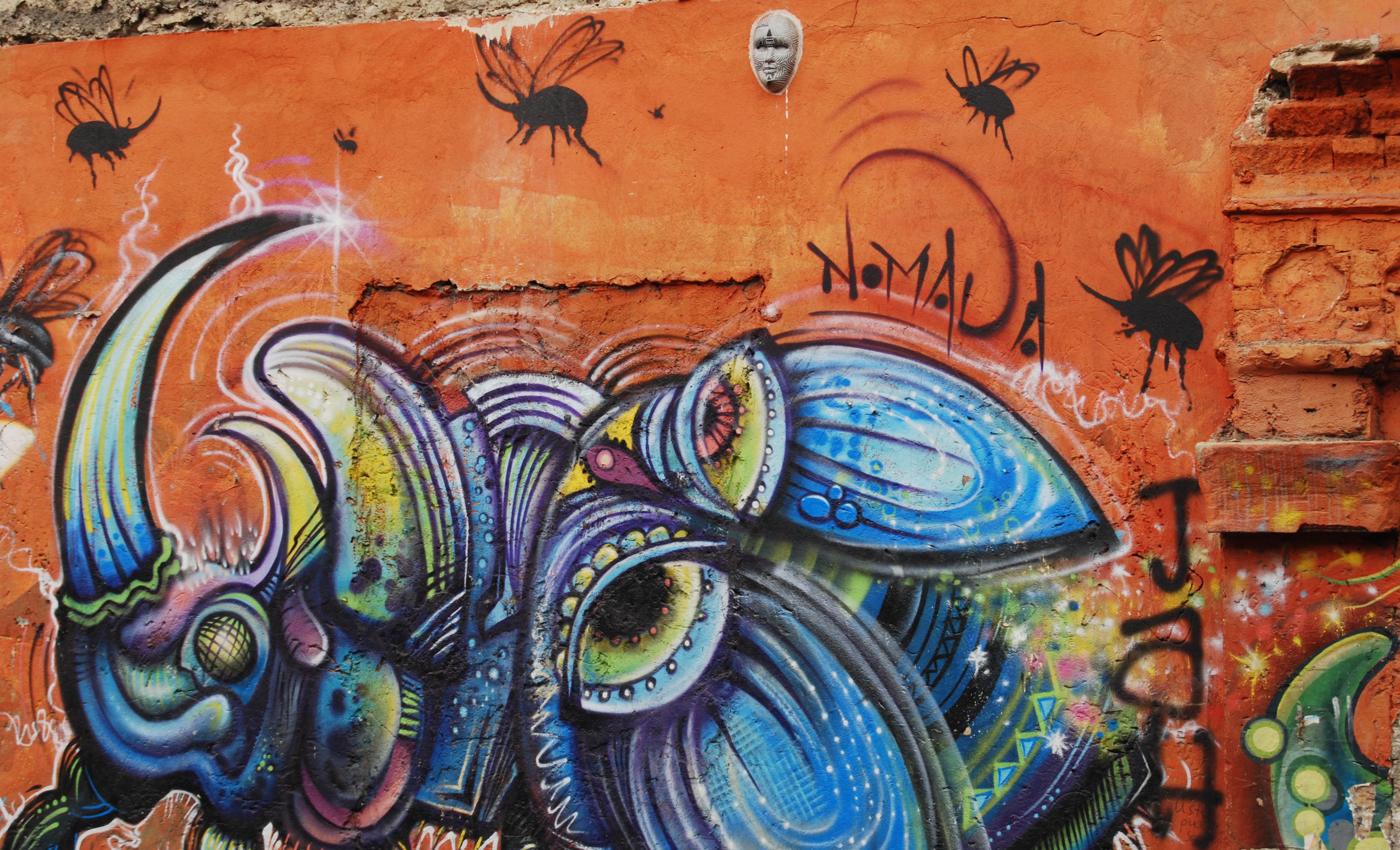
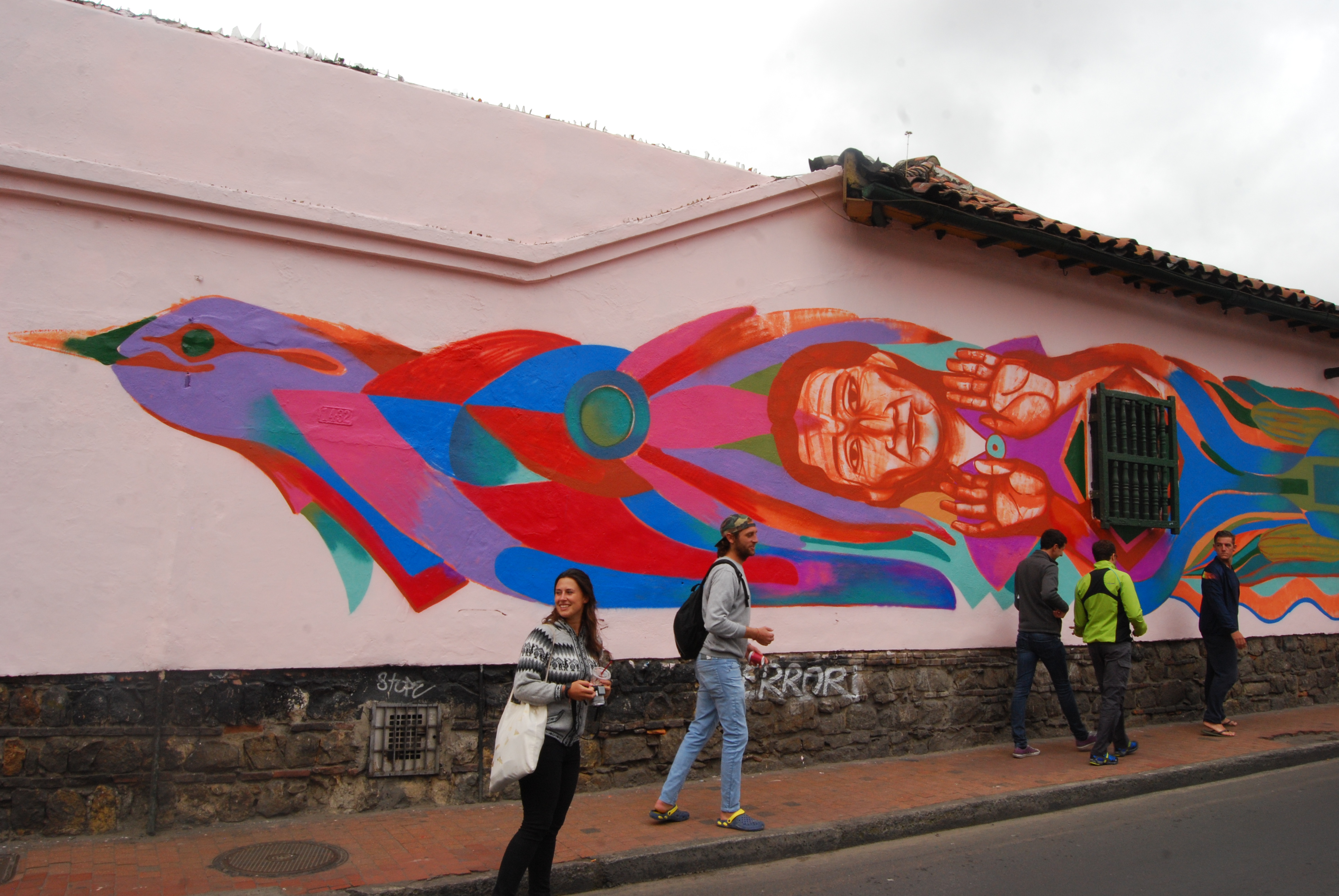
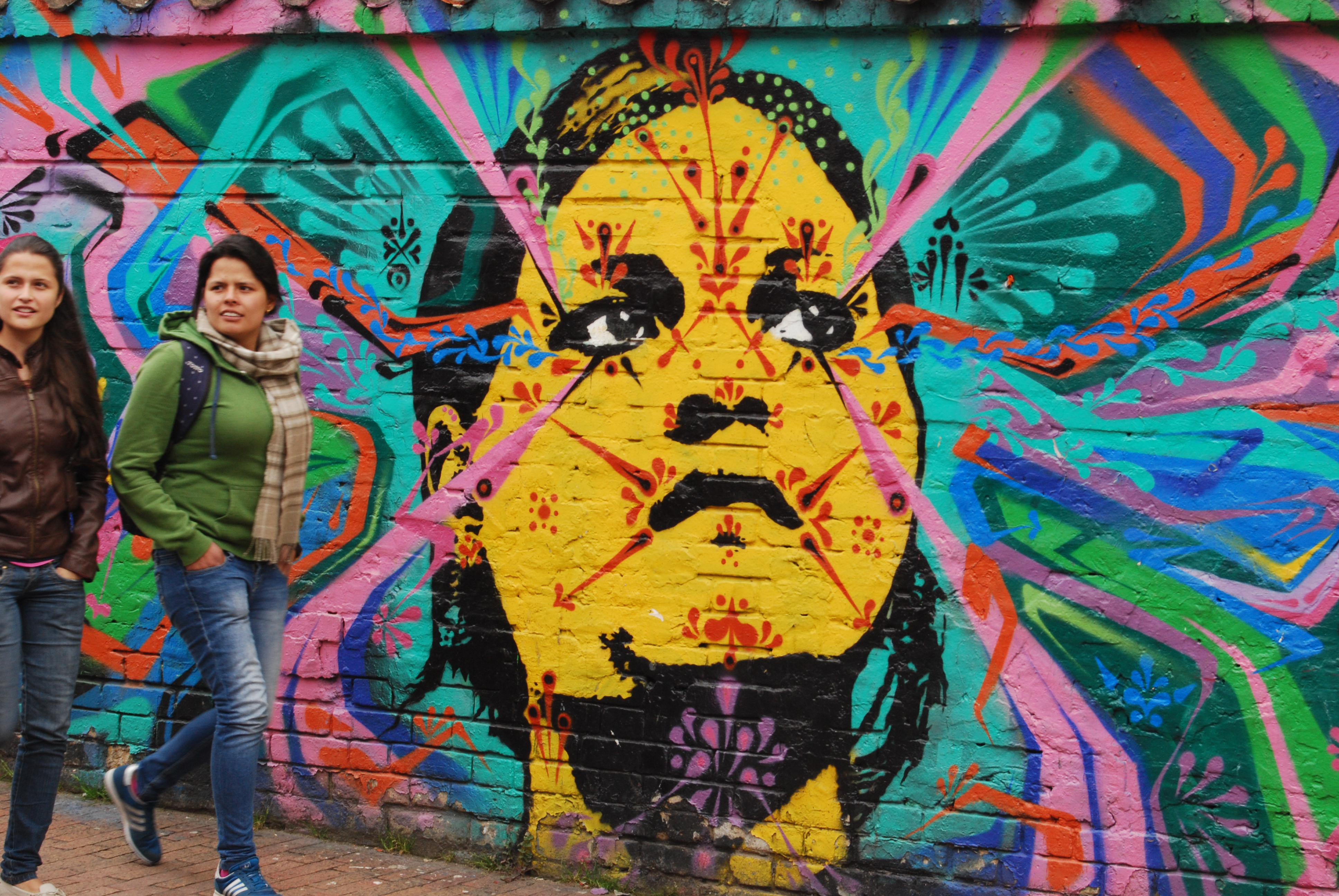
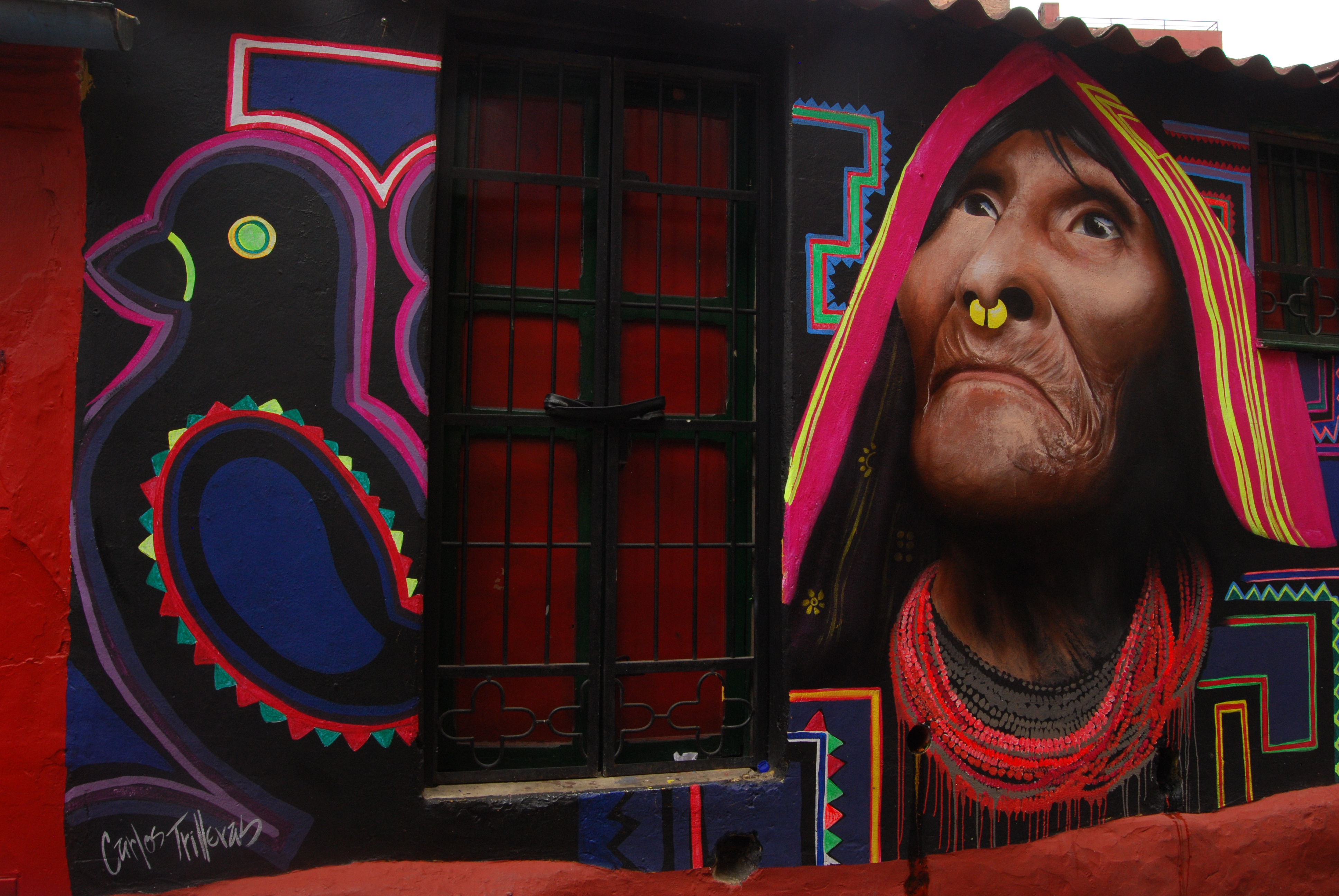
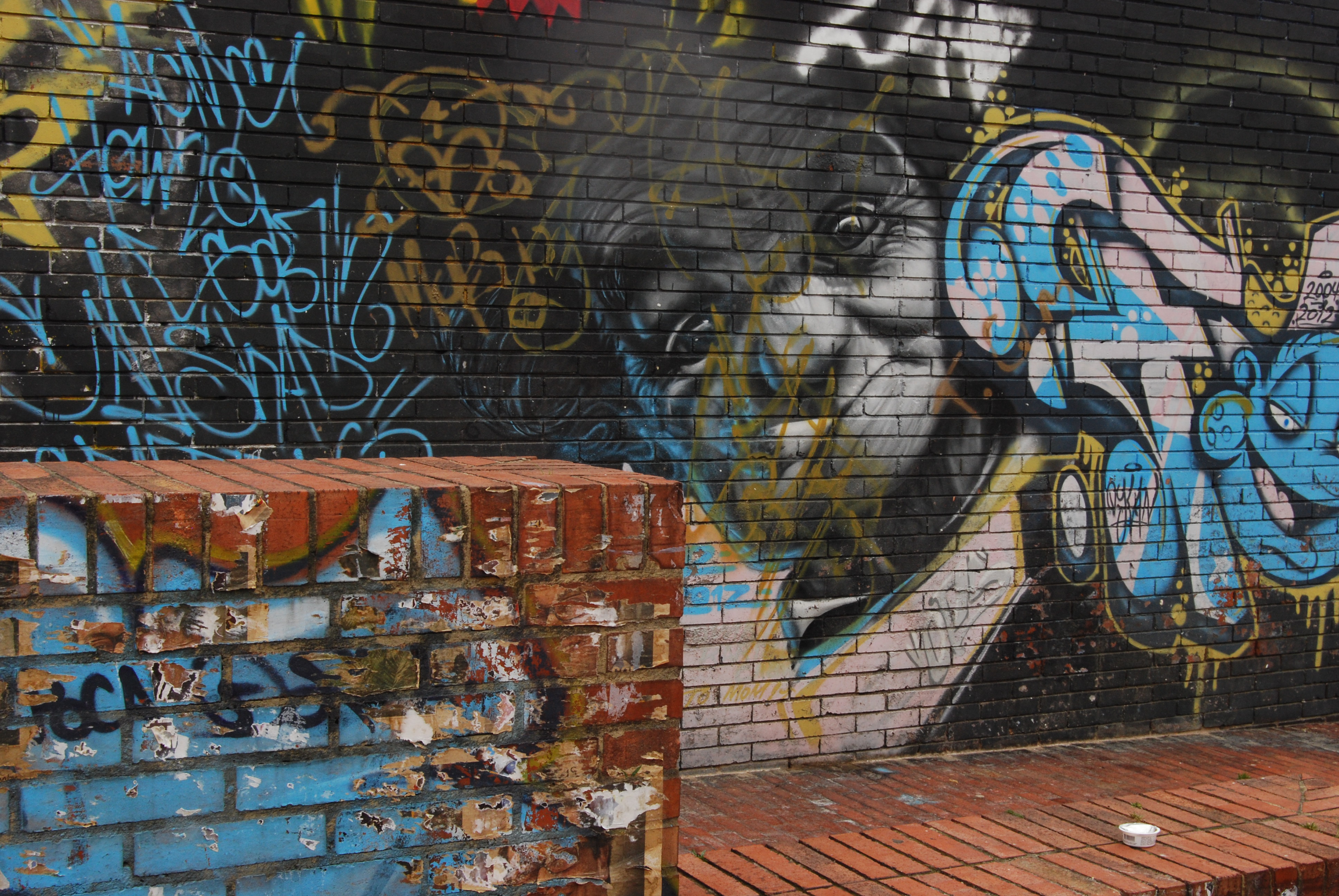
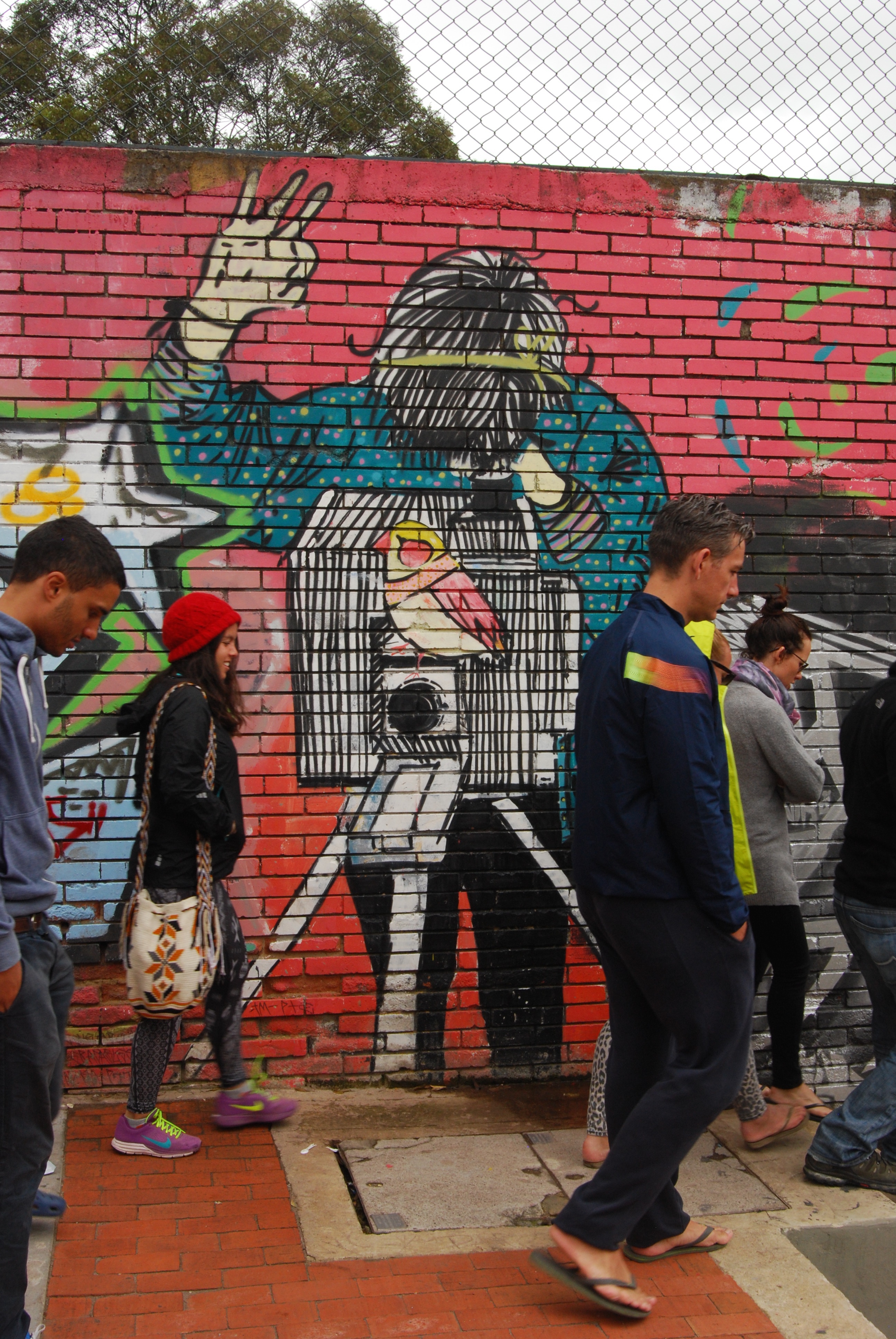
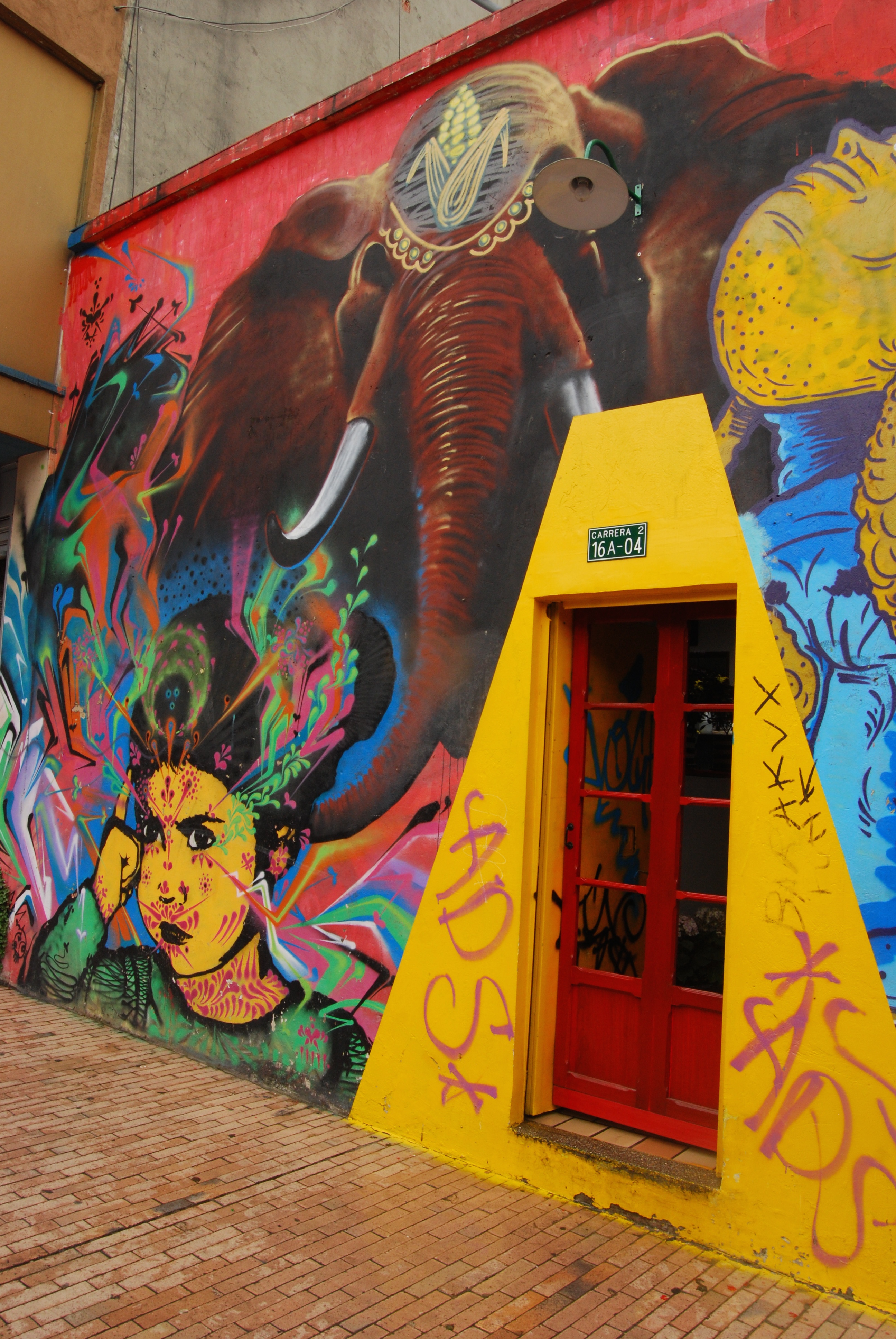
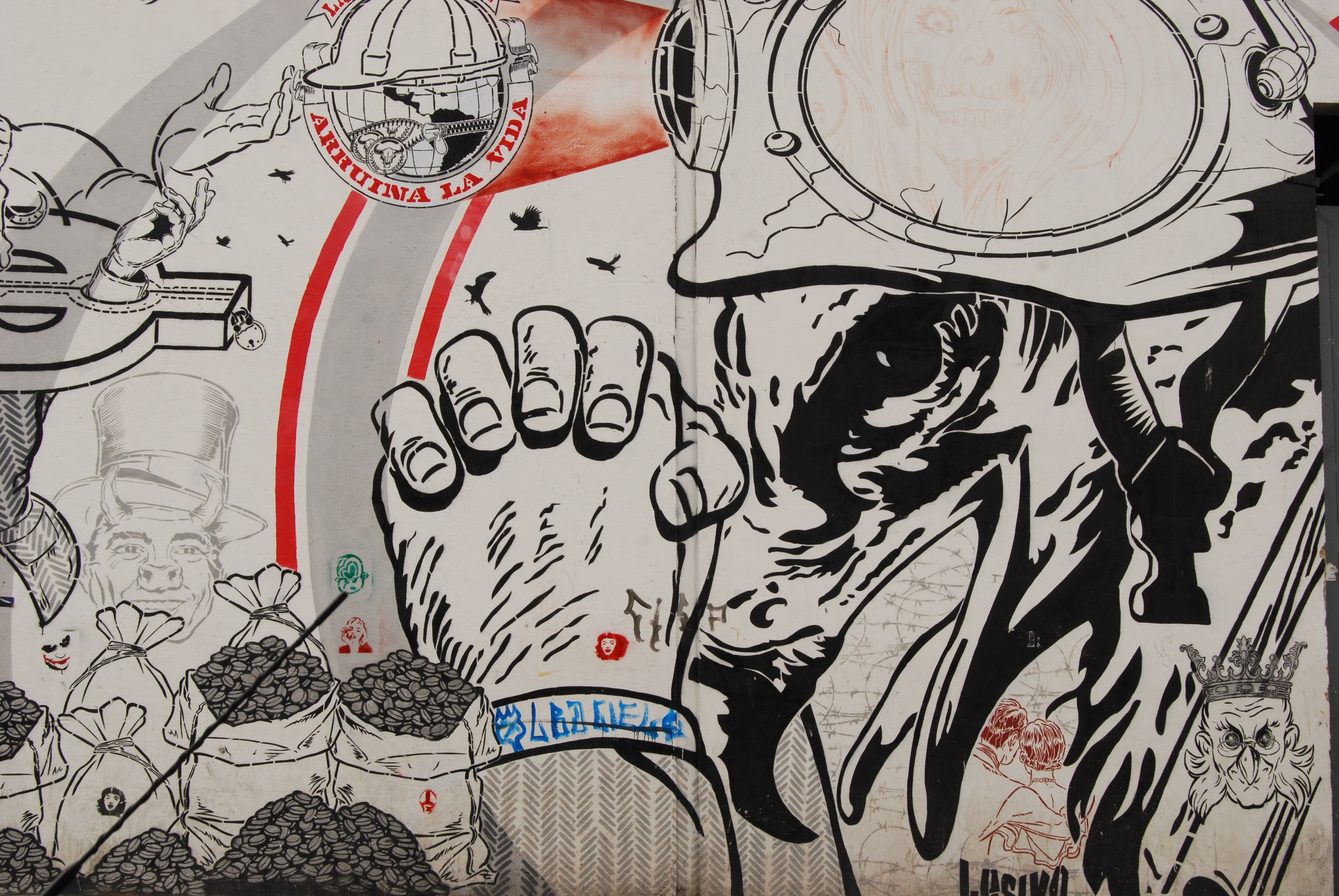
What do monochromatic walls have that graffitied walls do not? A sense of coherence, I guess, but that is not what civilization is about. Cities are made up of thousands of voices, the majority of which are never heard. The fact that Bogotá allows and even encourages the illustration of their public spaces provides a platform for the countless voices that might otherwise never rise above the babble. I appreciate this, and wish the United States would catch on.  Using art to speak is not a crime. I’d rather see this than advertisements on buildings in my city any day.

Hey, if you’re ever in Bogotá, go on this excellent tour of some of the city’s best graffiti, led by a resident artist.


The Benefits of Travel-Induced Fear

What is it about life that defies all expectations? I started this trip thinking I didn’t have any expectations, but now I think it’s absolutely impossible to go into any situation without subconsciously forming an idea of what will happen. Each day that has gone by, each step I have taken, has surprised me. I can already feel my travels hardening and strengthening me, breaking the mold I had created up until now. Traditionally speaking, I am homeless, and carrying all my belongings on my back has taken some of the softness from my body, a body whose favorite pastime had been sleeping in its own bed. Waking up each day with no plan or at best a very loosely-defined one has made me more adaptable and flexible. Finding myself alone in a big, big world has kicked the door wide open to what I am capable of. And yet I’ve also been reminded that I am not invincible, that as a woman and an obvious tourist some people see me as vulnerable and an easy target.

The feeling of belonging is one which is easily taken for granted. It’s not until you find yourself suddenly an obvious other that you are reminded of how comfortable belonging really is. But being an other is immensely important. It gives you perspective into the lives of people who are always other, like immigrants or minorities, it gives you compassion and empathy. Now I don’t personally think I’m ever really the sort to blend in with a crowd, but being a tall, white, blond woman in Colombia is like being a flamingo among sea gulls. We’re all birds but the outsider is obvious from a mile away. It’s enough to make one miss home, and I do, but missing home and wanting to go home are two very different feelings.

My time with Jessica and Adri is over now and suddenly I’m in a country where no one knows my name. The day they left was the first day that I felt something close to fear. Alone? On a continent to which the only connection I have is a hard-won language? It’s hard to explain this quasi-fear and why it’s not enough to deter me. I could say that I pride myself on facing my fears, and I do, but that seems trite and barely scratches the surface of why I’m doing what I’m doing. To be completely honest, I don’t know what keeps me going most days, and that’s not meant to be bleak. What is it in me that has made this possible? Why am I not content with my own bed and people who know me and love me and protect me? Why must I go out and find fear in the big world? Perhaps it comes down to this: I know there are things out in the world worthy of my fear, but there are also things that make risking that fear worthwhile, and for me, that knowledge is enough.

To illustrate the kinds of things I think worth braving fear for, let me share some of the things we all did together before my girls left.

For scale: Jess in front of La Piedra de Peñol in Guatapé, 2 hours outside of Medellín.

For scale: Jess in front of La Piedra de Peñol in Guatapé, 2 hours outside of Medellín.

We climbed 675 steps to the top, in spite of being in the end phases of a three day guaro (local word for aguardiente)-induced hangover.

We climbed 675 steps to the top, in spite of being in the end phases of a three day guaro (local word for aguardiente)-induced hangover.

But the reward was worth the work.

But the reward was worth the work.

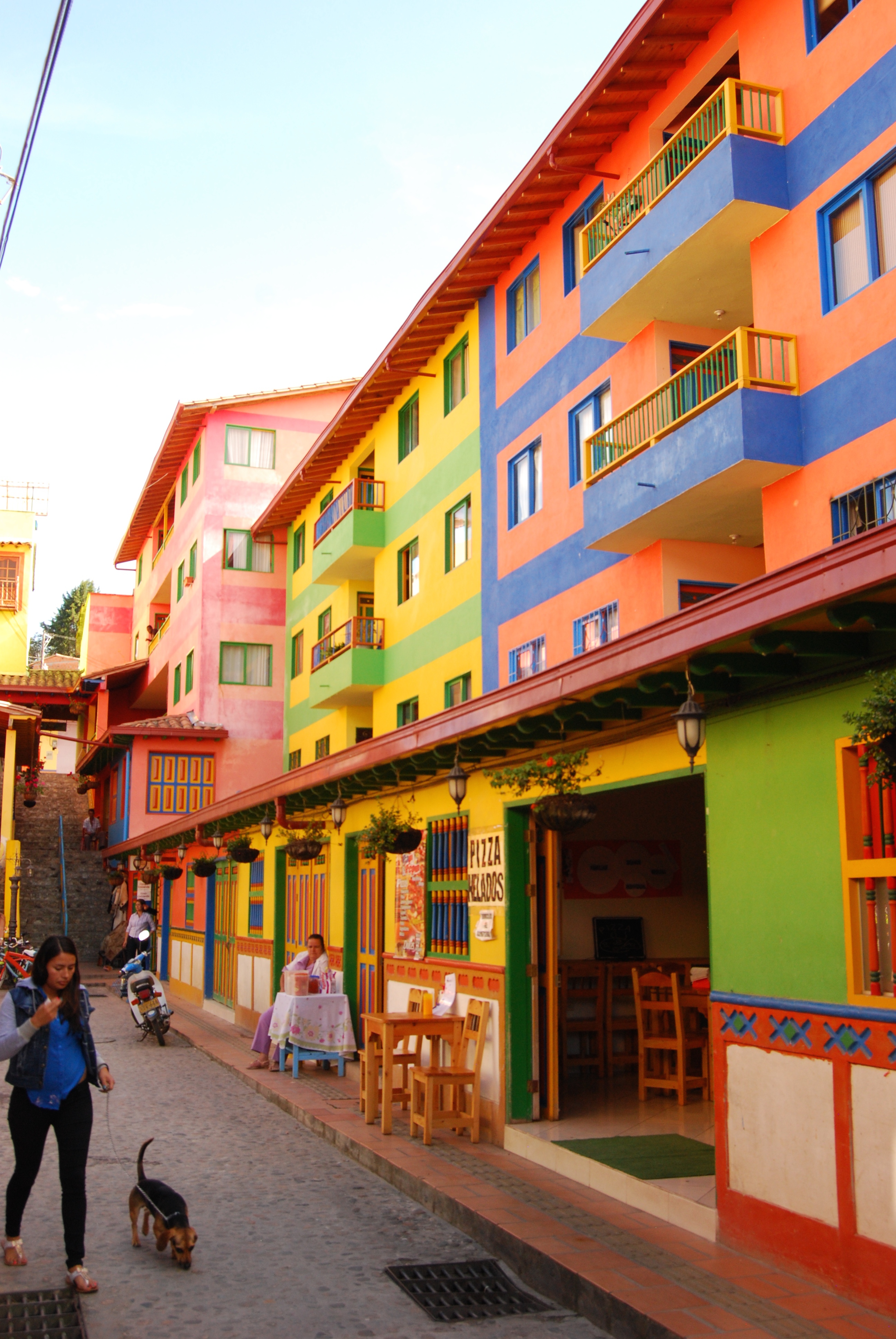
The town of Guatapé: a reminder of one reason why I love Latin America. The colors!

The town of Guatapé: a reminder of one reason why I love Latin America. The colors!

Adri on an impromptu climb towards La Virgen in Santa Fe de Antioquia.

Adri on an impromptu climb towards La Virgen in Santa Fe de Antioquia.

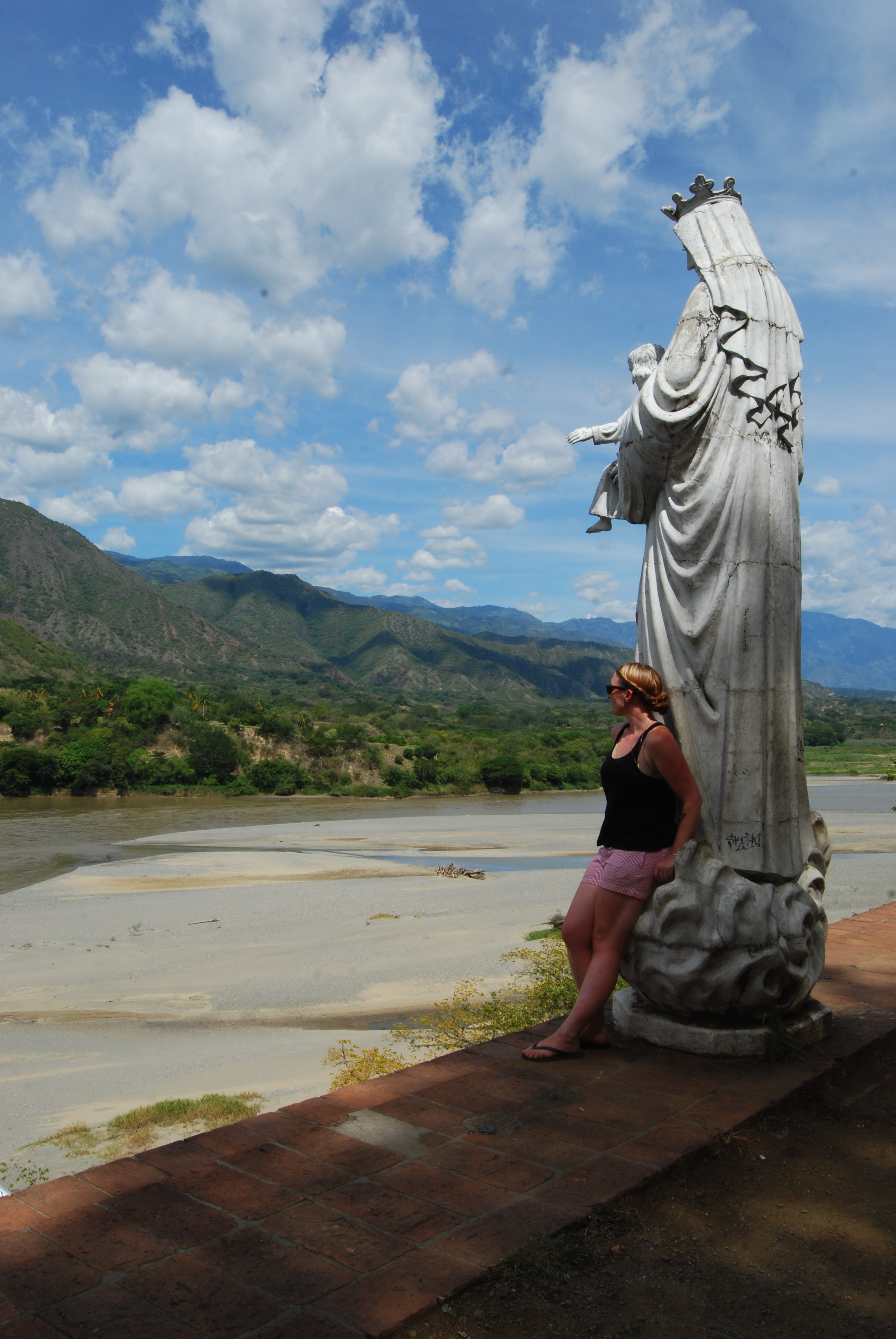
La Virgen and I overlooking the Río Cauca.

La Virgen and I overlooking the Río Cauca.

Jess and Adri deep within the Zipaquirá salt mines in the Salt Cathedral... being irreverent, of course.

Jess and Adri deep within the Zipaquirá salt mines in the Salt Cathedral… being irreverent, of course.

Fear is an incredibly important emotion. Sometimes it tells us when we’re in danger and need to be cautious. It reminds us that we are not infallible, not superheroes. It reminds us that there are people out there who can and will hurt us for personal gain or, even scarier, for no reason at all. But it can also be a useless emotion when it only serves to keep us from doing things. Comfort might be going to sleep in my own bed, surrounded by my things, near to people I love, in a city I know like an old friend, but it also means giving up seeing things, wonderful things, that can only be reached through a veil of fear. Fear can even keep us from meeting amazing people. I was a little anxious about my first Couchsurfing experience in Medellín, staying with a stranger and all, but by moving through it, we had the privilege of meeting and befriending the best host anyone could ask for. So yes, fear is ugly and I resent the way it can make me mistrust people I’ve never met or interacted with, but what you can find on the other side of fear is sometimes unutterably beautiful, so for now, I’ll take fear over comfort, and run with it.

Our host in Medellín, Esneider, and his hilarious friend Carlos.

Our host in Medellín, Esneider, and his hilarious friend Carlos.

No man is brave that has never walked a hundred miles. If you want to know the truth of who you are, walk until not a person knows your name. Travel is the great leveler, the great teacher, bitter as medicine, crueler than mirror-glass. A long stretch of road will teach you more about yourself than a hundred years of quiet introspection. -Patrick Rothfuss, A Wise Man’s Fear

Mountaintop Musings

It’s been thirteen days since my feet left American soil and I placed them firmly onto the tarmac in Cartagena, Colombia, but I swear to you, that could have been a lifetime ago. Those same feet have walked further and endured more in less than a fortnight than I ever expected they could. I’m sitting here now on the rooftop terrace of my hostel in Santa Marta, Colombia, my legs a constellation of bug bites (I just now pulled some kind of biting bug out of the soft flesh behind my knee), scrapes, and bruises, my feet blistered and swollen, my skin damp and flushed, and I’m still me and yet another me, too. There was a Kaelyn who flirted with bartenders and was reminded that her heart wasn’t quite as inaccessible as she pretended. A Kaelyn who danced and sang and writhed with the electricity she created within herself. A Kaelyn who was more joyous than any of the selves that came before. That woman is still here. But she’s evolving again.

Never has shedding a skin been so instantaneous. Traveling does that to me. Nothing is so painfully pleasurable as travel, there is no touch so rough or so gentle, no master as demanding and generous. I’m using sexual imagery here because travel is a power play, and I’ll tell you what, travel usually comes out on top, but boy do you benefit from being the bottom.  It turns you over and shakes you out. Suddenly, some assumptions you’ve held for who knows how long show their true, ridiculous colors, suddenly you are completely humbled, suddenly you find this amazing strength in yourself and find that you have given yourself a broader, more generous view of the world and the people in it. But enough with the abstract.

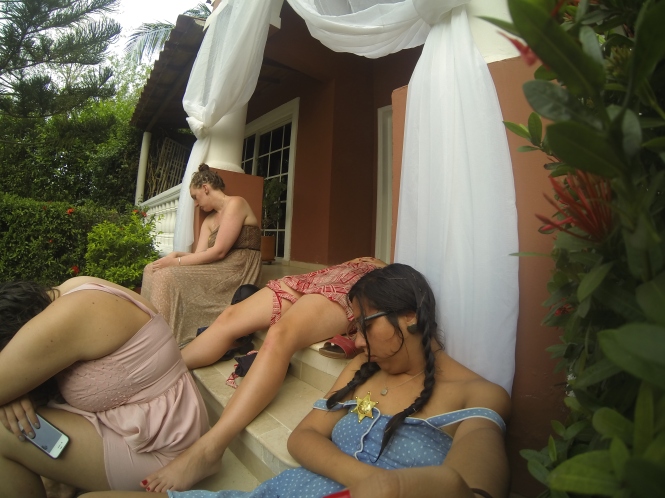
I won’t give you a play-by-play of my time here; the general idea will suffice. My time in Cartagena flew by. I have characteristically and whole-heartedly devoured my first shot of aguardiente (the local liquor which tastes like black licorice and goes down altogether too easily), a patacón con salsa (a king among street foods everywhere), mojarra frita (a fried fish which just might be one of my new favorite foods), various arepas and empanadas, probably too many Águila and Club Colombia beers, and a hot dog to put all other sausages to shame. I’ve found weightlessness and hilarity in a mud pit at the bottom of a volcano called El Totumo. I’ve partied from 5 to 5  (actually, 8) at a Colombian wedding only to literally fall asleep on the bride’s doorstep. You see, Colombia has already begun the process of  changing the girl who left home.
DCIM100GOPRO

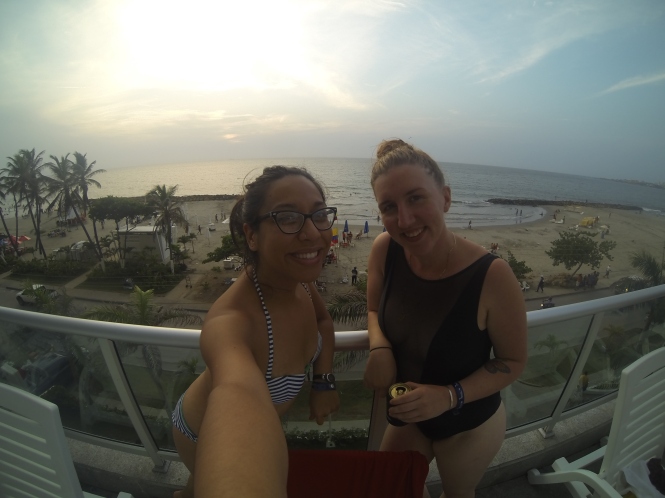
Jess and I on our balcony in Cartagena.
DSC_0041

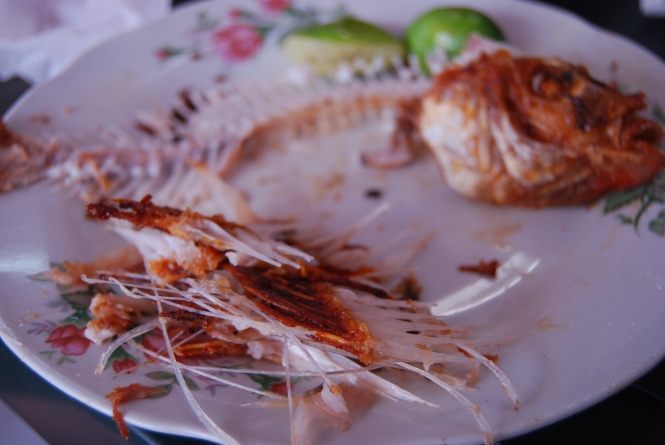
The remains of my mojarra frita… and moments before a hungry man snatched the head, spine and all, and ran out the door.
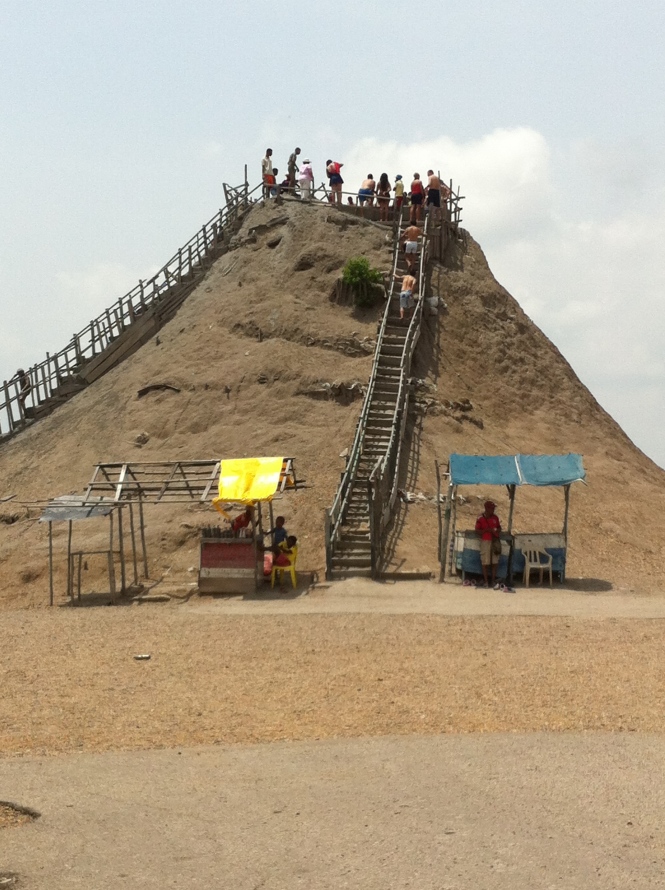
IMG_2169

El Totumo: we had to climb down a ladder into the mud.
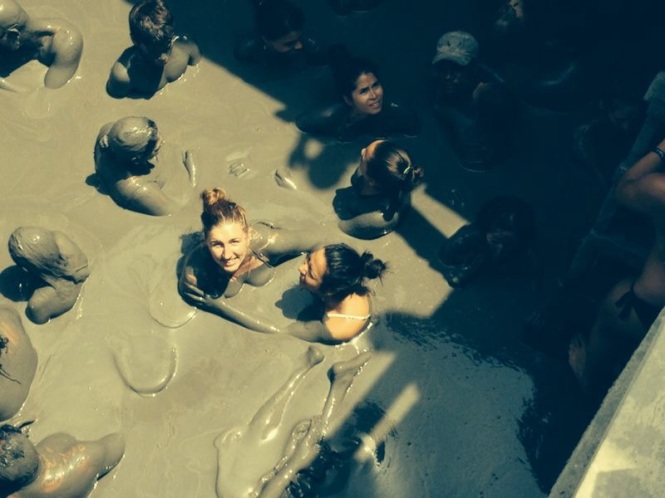
IMG_2185

Jessica and I in the mud bath.

Note: this photo is not staged.

Note: this photo is not staged.

Five days is not nearly enough time to get to know any place well and I hope to be able to give Cartagena a second look some time in the near future. For now, I’ll carry with me a picture of narrow streets with vines hanging from balconies, heat that softens your skin and frizzes your hair, and some pretty unbeatable street food.

We left Cartagena on Monday for Santa Marta, as we were scheduled to begin a hike to La Ciudad Perdida the next morning. The feeling of anticipation I had was not quite dread, but neither was I looking forward to it. For those of you that know me, you know as a child I would have rather sat in front of the TV and eaten a loaf of Wonder Bread than gone to play in the park across the street. As an adult, I’m a little better. I love soccer and yoga and surfing, but I have never been one for endurance sports, including hiking. And this was no ordinary hike and I was in no way, either physically or mentally, prepared for it.

La Ciudad Perdida, or Teyuna, is located in the middle of the Sierra Nevada mountain range. It was the sacred city of the now extinct Tairona Indians. It takes two days to get there, and two days to get back. I don’t know what I expected. I thought that my natural physical strength would carry me through, that five days wasn’t so long, that the brochure didn’t mention any level of difficulty so it couldn’t be too bad… I was so, so wrong. About an hour into the hike, after jumping into the river and thinking to myself “OK, this is cool”, we started going up a hill. That hill didn’t end for an hour. A half-naked man with a gold chain riding a horse came down the hill and I thought I was hallucinating, so exhausted was I already. That’s when I knew: this is the real thing, and it’s about to kick my ass. By the time we got to the first camp, I was feeling the beginnings of what would turn out to be some very serious blisters and nursing the bruised pride that came from acknowledging that I was not in the kind of shape that makes trudging up and down huge hills with a 25-pound backpack easy. I was done, agotada, and it was only the first day. Also, there was no toilet paper. Someone forgot to add that to the list of things we needed to bring. Some creativity ensued, but I won’t go into that. We slept in hammocks the first night, with toads the size of my foot hopping wetly beneath me, creating a chorus that did anything but send me to sleep. Think sleeping in a hammock is idyllic? In reality, it involves less blissful slumber and more sore necks and fear of flipping over. Add into the mixture the kind of hallucinogenic dreams that malaria pills deliver and you’re in for one wild night.

It was the second day that pushed me further than I’ve ever been pushed. By the time we stopped for lunch, the baby blisters on my heels had developed into full-blown sores and new ones were forming on each of my big toes. After a quick swim and some lunch, it was time to set off again, as there were still four more hours of hiking to go before we reached the base camp below Teyuna. Almost immediately, we started up another hill. Within ten minutes, I knew it was a hill to make every other hill I’d ever encountered laughable. In half an hour, I was convinced that every time I went around a bend, somehow I’d arrived back where I’d started because each bend was identical to the one before it. An hour in, I was sure that I’d somehow died and this was hell. Drenched in sweat, I was on the verge of tears when I practically fell onto the hill’s zenith. Never, never did I expect to subject myself to such extreme (for me) physical duress. Voluntarily, no less!

The next morning, after 1,263 worn, mossy stairs, we finally arrived at Teyuna and it was, of course, impressive. But as self-involved as it may sound, I was much more impressed with myself. Part of me knew that I was only halfway, that I still had to go all the way back to the beginning, up and down and up and up and down again to get there, but still, I had made it further than I would have thought possible. My friends and I agreed: something had changed. Some self-imposed limitation we had set for ourselves had just been completely annihilated, and it felt wonderful. The way back was pretty horrific in terms of the pain my blisters caused me (I now understand on a deeper level how the little mermaid felt when the price she paid for feet was to feel as though she were dancing on knives every time she took a step) but somehow that made the success even greater when I arrived back at the beginning. Whatever old Kaelyn had been capable of, this new one could do so much more.
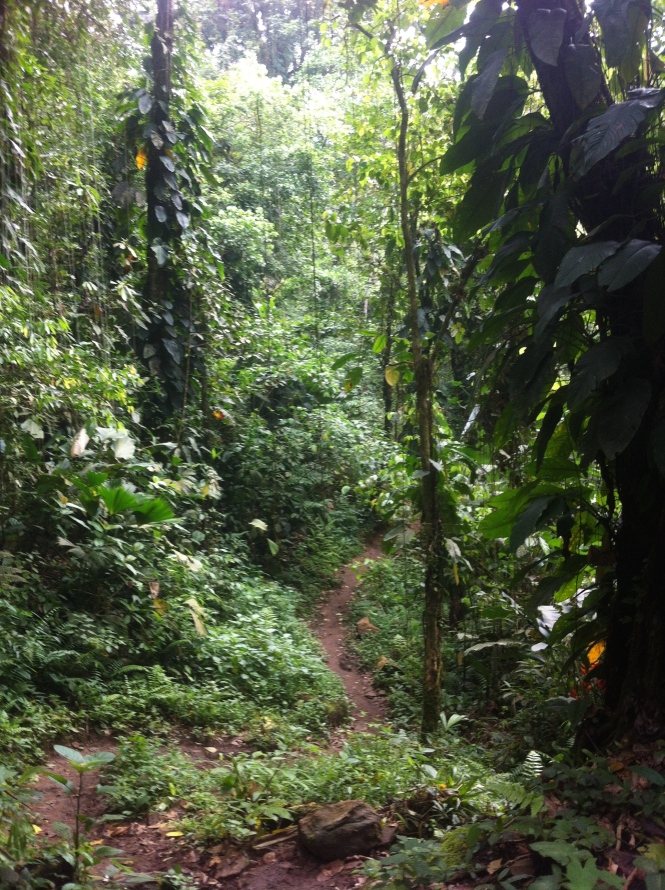
This should give you some idea of what I was dealing with.

This should give you some idea of what I was dealing with.

This isn't even the worst of it.

This isn’t even the worst of it.

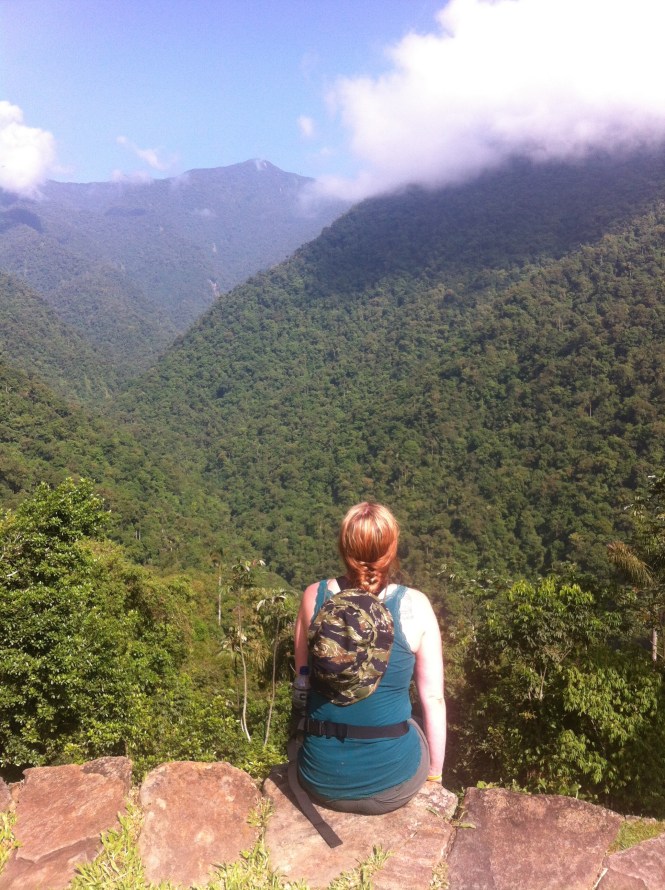
The view from La Ciudad Perdida, or Teyuna.

The view from La Ciudad Perdida, or Teyuna.

As a closing note, for me the ruins were not the highlight of the trip in terms of things seen. It was something else, something simple and half-remembered. I woke up in a cold sweat after a particularly horrible Malarone-nightmare involving an ex-boss who I found out (in the dream, at least) was a serial killer of women and had me trapped in an elevator. All around me, swathed in mosquito netting, were my fellow hikers, but the dream had left a film of clenching fear on me, so I got up and walked outside and then, I looked up. Never had I seen the stars as I saw them in that moment. There was no electricity for miles. I was in the middle of the Colombian jungle. The stars were shining as they had never shone for me. The Milky Way looked tangible, like I could reach up and wrap it around myself, like a shawl. Orion was on the horizon to my right, and that warrior-god always reminds me of my dad, who first pointed out the three stars that make up his belt, and it was this reminder that chased away the evil vestiges of my nightmare. The world is enormous, but it is also small, and the people we love are with us always.

Knowing this, I went back inside and fell asleep.


The Apotheosis of Kaelyn Davis

There is so much space between dreaming about what you want to do and actually doing it that many people never make it. Some dreams when unachieved will haunt our hearts forever. There is nothing quite so unproductively embittering as what ifs. But some dreams change or are replaced by others, and the original dream becomes something to laugh about over drinks with good friends. I once dreamed of being a ballerina and although I still love to dance, I veer more towards salsa and freestyle booty shakin’ than pirouettes and pliés. Then there are the dreams that depend on other circumstances, dreams that I would like to achieve, like living in Paris and getting my Master’s in TESOL or English, but if they don’t happen, it hopefully means I’ve done something else equally meaningful. But there are some dreams which have stayed more or less at the forefront of my consciousness for over a decade now, putting pressure on my heart at the most unexpected moments, like little barbed whispers that say psssstt… get going already! These are the dreams which I predict will wilt slowly if unfulfilled, darkening but never disappearing, murmuring what if as they fade away into impossibilities. One of them is a cross-country road trip, which was further fueled by reading Blue Highways by William Least-Heat Moon. Another is teaching English as a Second Language in a new and foreign country. It’s this latter one which I have decided to nurture after years of telling myself later, later, and so it’s here, finally, where the point in time when I began to dream and the moment when I actually set out to achieve it meet, and guess what? After all this time, I am. So. Ready.

Here’s the deal: In 4 days I will be on my way to Cartagena, Colombia with two of my friends. If our past travels together show anything, it’s going to be a trip we’ll talk about for years to come. We are a force to be reckoned with when we’re together. I am nothing but excited for this trip. But where my feelings get a little more complicated is when I think about my friends leaving. After about 3 1/2 weeks, they’ll be on a plane back to California, and I’ll suddenly find myself alone in Bogotá. You see, I’m not coming back, not for a long while. Not everyone is supportive of this decision. People have said things to me like “You’re going to South America? Alone? Aren’t you scared? Don’t people get kidnapped there?” or even “Are you just putting off finding a career?” I’m not worried. I am a cautious and intelligent urban citizen and traveler. What people who don’t travel seem unable or unwilling to understand is that there are just as many horrible things that can happen to you in your own backyard as in a foreign city; the threats just look different. So no, I’m not scared. I’m not worried. I’m realistic. I know anything can happen, and I’m as prepared for anything as I can be. And as for that last question, no, I’m not putting anything off.

I am comfortable saying that I have only moved forward since I moved out of my parents’ houses at 17 and left Orange County for San Francisco. I’m 26 years old, I have two Bachelor’s Degrees, I’ve lived in Paris (admittedly, only for a month) and Mexico (a year), I’ve had a few dead end relationships, I’ve worked in all sorts of jobs, from Joe’s Crab Shack (where, yes, I had to dance every 45 minutes and ask people if they were ready for a “crab facial”) to being a personal assistant/maid/secretary to a well-known fine press publisher who, in his own words, told me he wanted me “silent, but cheerful”, and I’ve been 99.9% financially independent for the last few years. I am confident in who I am and what I’ve accomplished and I believe my dreams are as valid as anybody’s. Plus I’m hoping that, just maybe, teaching English as a Second Language is the career I’ve been searching for.

Eventually, the plan is to end up in Santiago, Chile (via Ecuador, Peru, and Bolivia), and there get a job teaching English and see what happens. But first, I have to get there. I have only the vaguest outline of a plan, less money than I would like, and only the confidence in my own resourcefulness and instinct for survival (and a handy Spanish fluency) to help me along. It’s like I’ve been on a river my whole life till now, a relatively steady river, with only a couple of serious rapids and hidden dangers, and now ahead of me all I see is the horizon. I’m steps away from a cataract of unknown height and ferocity, but I desire with my whole heart to see what’s at the bottom, and I will embrace it, for better or worse, but hopefully for better. I think that’s enough of the Pocahontas-esque visuals, though.

The last few months leading up to this jumping off point have been a chaotically fun bacchanal of eating all my favorite foods, stuffing myself on corn tortillas and IPAs (which an inside source told me are scarce in South America), spending as much time as possible with the people that I love, and pretty much just enjoying the fruits of my life thus far. To the people I’m leaving behind (for a while!) I want to emphasize how much your support and love and friendship has meant to me. Each one of you has made me the person I am today and I don’t know where I would be without you. You have all brought so many amazing things to my life, and I am so, so grateful. It is because of you I have the courage to do what I’m doing. There’s nothing quite like leaving to make you appreciate the things and people who are staying behind.

As this has turned into quite a lengthy post, I will wrap it up with my hopes for the next couple years of my life. I hope to push myself further than I ever have before in order to find out just what I am capable of. I hope to see things that previously only dreams were made of, to meet people and form relationships that seem predetermined in their serendipity, to eat guinea pigs on sticks, pet the resident llamas of Machu Picchu, fall in and out of love with people and places, burn my feet on the sands of the Atacama Desert, and discover whether or not ESL is something I want to pursue further. The long and the short of it, my friends, is that I want to continue finding out who I am and what I want from this life. I don’t believe in destiny. I believe we create a destiny for ourselves by the choices we make; we mold ourselves out of the primordial clay. If you thought the title of this entry was arrogant, I can see why. But it’s not arrogance you felt, it’s power. I’m on the edge of something and I am not afraid. I feel fucking powerful. I have absolutely no idea what might happen in the next 18 months, but I promise you it will change my world.